Showing posts with label Historic. Show all posts

Monday, March 16, 2020

A Land of Myth, Mystery or Men?

 So if this Golden Fleece thing was just a smash and grab job, why is Georgia so important?  

    It would seem that Georgia has been a crucible for mankind since before we were mankind.  As related in an earlier edition, multiple Pre-Homo Sapien specimens have been found in the region of Dmanisi.  Under present anthropological understanding, the importance of this find would have been meaningless - or worse, mis-interpreted - were they not found in such close proximity to each other, as in Dmanisi.  As I understand it from reading in the Georgian National Museum, this has never been found before.  Why were our earliest humanoid species discovered together outside Africa in Georgia?  A distance of at least 1,600 kilometres (1000 miles).  Could they have been at the meeting with God (entry 24 February 2020)?


Skull, Homo-erectus(Author's collection)


    As noted in the last several entries, evidence of contact between Hellenic Greece and western Georgia was effected in approximately1200BC through Jason and his Argonauts but their knowledge of the Golden Fleece in Greece begs the question: who told them about it?

    In Greek Mythology we encounter Prometheus.  A demi-god of the heroic nature but one that ran afoul of his full-blooded cousins by stealing the secret of fire and giving it to mankind.  For this transgression, he was chained to a mountain top where an eagle pecked his liver out by day and it re-constituted itself by night.  That mountaintop was non other than Mount Kazbegi located in Georgia on the border with Russia along the Georgian Military Highway.  Georgian mythology has a similar character who suffered the same fate named Amirani.  Did Jason return with that bit of information too?


Mount Kazbegi centre image (Author's collection copyright 2020)


    The concentration of unique languages is prolific in the Caucasus as well.  It seems that every mountaintop speaks a different language (not dialect) and most are too old to have an alphabet.  The Georgian alphabet itself is among the oldest in the world.  Interestingly, mythology comes to the rescue here as well.  Local legend has it that while distributing languages to the world’s people, God placed all the languages in large panniers and mounted them on a donkey for easier transport.  While walking over the Greater Caucasus Mountains, the high, jagged peaks tore the bottom of the panniers and many languages fell across that small area before the holes were patched.


Georgian village in Svaneti Region of Georgia
(Author's collection copyright 2020)


    Life in the Caucasus has never been easy and it takes a hearty breed to survive.  It stands to reason that anyone standing out in a crowd like that would be legendary in their exploits.  This holds true for Georgia.  Many larger-than-life characters have existed throughout time.  King Vakhtang Gorgasali was said to have been deer hunting one day in the fifth century AD.  He was in an unfamiliar region, a bog-ridden area next to the Mtkvari River when he wounded a stag with an arrow.  King Vakhtang chased the wounded deer into the bogs where it disappeared from site through the morning mist but he heard it fall into the marshy waters.  So sure was he that the animal was dead that he ran forward unprepared, only to see the stag emerge from the waters unharmed and run away unscathed.  Bewildered by this, he investigated the reason for it and is credited with discovering the curative waters which gave rise to the city of Tbilisi: the capital of today’s Georgia.


Hamams in Old Towne Tbilisi (Author's collection, copyright 2020)


    Later, after a war with the Ottoman Empire, Tsarist Russia was trying to “Tame” their recent acquisition called Georgia and many a hard man was drawn to the Caucasus to test his mettle and make his fame.  In fact, a large body of Russian literature is linked to the wars of oppression in the Caucasus and one of the greatest insurgencies ever fought took place there: driven by the unbending will of its best known leader, Imam Shamil, an Avar from today's Daghestan.  With drive in mind, history would soon recognise another Georgian: Ioseb Dzhugashvshvili.  We remember him as Josef Stalin and he killed millions of people trying to impose his will on the world under the guise of communism.  


     Perhaps, unbending will is the true mystery of the land God reserved for himself.  Each individual I met there, over decades of interaction, was a force to be reckoned with - men and women both.  So if the region's mystery is, indeed, the unbending will of men, Caucasians most likely created the circumstances from which myth emerged and with this en-ending supply of wilful people, the Caucasus has remained prominent in the development of mankind since the dawn of time.


Monday, March 9, 2020

So what really happened?

      Legend tells us that a generation before the Trojan War, in ancient Thessaly, King Pelias stole the throne from his half-brother King Aeson.  In doing this, Pelias made a dangerous enemy in Aeson’s son, Jason, but sent him off on a quest to the empire of Colchis (modern day Georgia).  If completed successfully, this quest had the ultimate pay-off - Jason would be crowned king of Pelias and if he failed, Jason would pay the ultimate price.  To this end, Jason surrounded himself with some of the greatest heroes of the day and it was these heroes and their exploits that grew into legend.  This is the story first related in the third millennium BC by Apollonius of Rhodes entitled, The Argonautica.
All legends are based in truth and this one is no different.  It would appear that wealth and nation building were paramount to would-be-kings even thousands of years ago.  All empires need a financial reserve as well as sustained revenue and it was well known that Colchis was rich in gold. What made them so rich was their particular methods of acquisition.  The Rioni River and its tributaries were populated with wooden vessels outfitted with sheep skins that would take advantage of the rivers’ currents to sift the gold particles as they flowed out of the Greater Caucasus Mountains.  It is not hard to believe that over the millennia, such a simple but revolutionary technique would become the myth of the Golden Fleece.

Colchian earrings - circa 1st millennia BC. (Author's collection, Copyright 2020)

If true, it would seem that the real reason for this exploit was the acquisition of technology - not a simple smash-and-grab robbery.  Think of it like the old adage, “give a man a fish and feed him for a day.  Teach him to fish and you’ve fed him for life.”  Is that the real reason Jason surrounded himself with demi-gods?  How else could one expect to acquire such sensitive information?  

Jason knew that he had to have every skillset possible in order to have any chance of success.  

       Historians and storytellers differ in their passenger list aboard the Argo but generally agree that 50 crewmen were necessary and among the crew there are a few names that always appear: Heracles, Castor, Pollux, Peleus and Telamon.  It was these men, with their varied specialties and capabilities, who had been brothers in arms for such a long time that made Jason's success nearly a forgone conclusion.

Necklace from Vani, Georgia - circa 1st Millennia BC. (Author's collection.  Copyright 2020)


So we see that financial stability and corporate espionage were most likely the basis for the exploits we call the Quest for the Golden Fleece and in an effort to ensure success, Jason surrounded himself with men capable of a variety of skills - skills like; cunning, strength, intelligence and endurance.  Skills that may or may not be required for success but whose lack, when needed, would ensure failure. 
        Yet, in the end we see that for all his planning, preparation and coordination, it was an unforeseen capability that won the day for Jason: magic.  The magic of love when Medea fell for Jason and agreed to help him steal the Golden Fleece from her father, King Aeetes of Colchis.

Bracelet from tomb in Vani, Georgia - circa 1st Millennia BC.
(Author's collection. Copyright 2020)


Monday, March 2, 2020

Origins of the Golden Fleece Myth

    In European culture seeking wisdom - especially hidden knowledge - finds its reflection in the symbols associated with gold: the Golden Fleece, the Philosopher’s Stone and the Holy Grail.  For all the qualities it embraces - this eternal and most noble of metals - gold was recognised as the metal of the sun.  It has become the foremost physical medium for the expression of men’s spiritual endeavours and the scientific knowledge about working gold is seen as one of the revelations of wisdom itself.

Detail on a 18th century BC cup from Trialeti depicting a religious ceremony.
(Author's Collection. Copyright 2020)

  The two phenomena: gold and knowledge, especially the knowledge of gold amongst the Colchians, were the genesis for rationalising the myth of the Golden Fleece.  It was this Golden Fleece that was the main goal of the first long-distance maritime adventure in mankind’s recorded history.  The Greek philosopher and mythographer Euhemerus went so far as to interpret the Golden Fleece as a technique of writing in gold on parchment or a book written on skins which describes the method of obtaining gold by means of chemistry.

Fourth century BC example of Colchian goldsmith techniques.
(Author's collection.  Copyright 2020)


  Why is the myth of the Golden Fleece - which emerged from the culture of classical antiquity and pursued its life in the alchemy of Medieval Europe - connected to Colchis?  The answer to this question may be found in Greek written sources that mention Colchis as “rich in gold”, similar to the cities of Mycenae, Sardis and Babylon which were all famed for their wealth.  Perhaps more significantly, the answer lies in the knowledge of obtaining, working and using gold for high spiritual goals - the wisdom that was continuously refined, preserved and passed down throughout the centuries in the territory of Colchis and the entire country of Georgia. Today we witness the demonstration of this wisdom in the golden artefacts found all around the country we call Georgia and we continue to re-discover these techniques and knowledge through our study of these pieces of history.

Colchian fourth century(approx) plaque depicting bull, boar and lion.
(Author's collection. Copyright 2020)


Monday, February 10, 2020

Feats of Engineering or Imposition of Will?

  Flying over the Rhine River last week I was struck by its size.  It is truly a massive obstacle, one that slowed the Allied advance into Germany only 70 years ago, despite their modern technology.  They were forced to be creative in their river-crossing techniques and even had to resort to boat crossings in some places.  
    Caesar writes that in 55 BC boat crossings were beneath him, so he had his field engineers build a forty foot wide wooden bridge across  the Rhine in ten days - including the time to fell the trees!  Scholars believe this crossing to have been accomplished somewhere between Andernach and Coblenz where, today, the river is between 250 and 300 metres wide.


Author's image of a drawing from Caesar I Gallic War, Loeb Classical Library, 1917.
     
    The Roman engineers devised a method of re-enforcing the supporting timbers using the strength of the river’s current while topping it with a paved road as well as building defences upstream to deter and defend from waterborne attacks.  Caesar doesn’t mention any attacks from the Suebi Tribe - whom he invaded Germania to subdue.  In fact, Caesar never engaged them in combat.  He conducted punitive raids against their villages and signed treaties with their enemies: demonstrating that the Rhine was not Rome’s northern border.  So after 18 days in Germania, Caesar decides his goals have been met, whence, he crosses his bridge back into Gaul and destroys it behind him.  
    It is this willingness to do the impossible which made Rome great.  Whether involved in 360 degree siege/counter-siege warfare - as was the case at Alesia - or imposing their will on rebellious natives; Roman technology, accompanied by Roman courage built the world’s largest empire to date.

    Looking at today’s bureaucracy riddled command structures one must wonder what an unencumbered will, like Caesar’s, might impose on a less committed foe.

Monday, February 3, 2020

Time and Patience: the Most Powerful Warriors. Conclusion


    Through all these examples we see that sky watching played a large part in the daily life of Ancestral Puebloans.  The only question is, why? Why was so much effort put into building these great houses with so much care and to such exacting standards?  Why were tens of thousands of trees brought from as far away as 100 kilometres (62 miles) without the aid of animals or the wheel?  Why does it seem the mid-twelfth century was a dividing line in Chacoan culture?  Remember, it was prior to 1150 that the south/southeast (S/SE) orientation was predominant in local architecture and after that cardinal alignment took precedence.  During this same fluorescence period calendrical stations seem to have become very important but they were typically located on sites important to their ancestors.  If that weren’t enough, it seems Chaco Canyon itself may have been occupied due to its alignment with the 19 year greater lunar standstill through its southern mesa topography.  

Tower kivas (gateways to new worlds) in Kin Kletso Great House (Author's collection, copyright 2019)

    This demonstrates the great value Ancestral Puebloans placed on commemorating the cycles of the sun and moon.  Chacoans built the azimuths of sun/moon rise and set, its mid-points and extremes into their architecture on micro and macro scales.  Over the centuries this reverence for time became heirophany and, therefore, impossible to ignore but not impossible to walk away from.


Clusters of kivas inside Pueblo Bonito (Author's collection, copyright 2019)

    All these deliberate activities help to integrate the canyon into a meaningful unification of heaven and earth - but this only brings us back to why.  Why go to all this trouble?  We can see the organised and predictable nature of  Chacoan worship and how it lent itself to creating large festival opportunities: most likely the backbone of a vibrant economy.  This economic well-being was probably based on the commerce created by the well planned arrival of pilgrims attracted to these rituals.  These markets and fairs would have been large enough to allow the Chacoan system to become a clearing house for not only a variety of goods, both foreign and domestic, but also ideas and ideologies, both political and social; all of which would have helped shape the Chacoan world.  This well-organised system would have created political stability for the Chacoan elite and so it was imperative that they remain relevant to their population in order to stay in power.  Its not hard to see that the introduction of new traditions and the physical changes associated with them may have been one manifestation of this quest for relevancy that we can see today.  


Monday, January 20, 2020

Time and Patience: The Most Powerful Warriors. Part Five


    The calendrical station is our last subject concerning archaeoastronomy in Chaco Canyon.  This most recent subject is one of great controversy due to the willingness (seemingly) of some investigators to use irrelevant information in a relevant manner in order to aggrandise the Chacoan culture (alla Keynesian economics).  There is no need for that as Chacoan astronomy and its resultant culture are mind-boggling.  We will stick to facts alone in this article.
    Chacoans watched the sky, day and night.  Ethnographic proof is evident in every Pueblo tribe extant today and some are more ardent watchers than others but every tribe has astronomers.  This overwhelming commonality speaks volumes about the importance of the sky to Ancestral Puebloans.  

Super nova pictograph below Penasco Blanco.  Thought to be from an event in 1054 when an imploding star was visible during the day.
(Author's collection. copyright 2019)

Calendrical stations, simply put, are specific locations from which to track celestial activity across the sky.  Besides being a nice, relaxing pastime, this activity is the key to successfully charting solar activity as it relates to the time of year and - in a larger sense - when to conduct certain activities, like the planting of crops.  Properly conducted, this activity also allowed the Chacoan hierarchy to prepare the masses for upcoming festivals.  This would allow pilgrims travelling from satellite regions to be on time as well as markets to be prepared for the pending events: markets which strengthened the economy of the Chacoan World and re-inforced the validity of its ruling class.
    In Chaco Canyon there are several examples of calendrical stations and they are all linked to the fluorescence period.  In large part, these sites are associated with winter solstice prediction and are located near the Wijiji and Kin Kletso Great Houses as well Headquaters Site A (a backfilled site near Una Vida Great House).
   The original construction of Kin Kletso was completed by 1130AD (approx) and contains both anticipatory and confirmatory markers of the Winter Solstice.  Aligning the southern wall of Kin Kletso with the base of the cliff to the southeast gives a 16 - 17 day anticipation of the solar event and sighting the northern wall against the same cliff base indicates the day of the solstice itself.  Additionally, a large boulder near the north wall may have been the original calendrical station prior to construction.
    
Kin Kletso looking SW from canyon rim.  Previous calendrical station is the large rock (on canyon floor) in upper right picture in line with structure's north wall (Author's collection.  Copyright 2019)
    In the eastern end of Chaco Canyon is another great house: Wijiji.  This location was apparently built in one effort in 1110AD (approx) and was never occupied, lending credence to the supposition that it was created specifically as a calendrical station and fuelling speculation that this was an effort to revitalise a faltering religio-economy.  This great house exhibits signs of both anticipatory and confirmatory  stations in its architecture as well as in the surrounding terrain.  When standing at the northwest corner of the structure looking southeast, there is an apparent notch on the distant horizon.  16-17 days prior to the Winter Solstice sees the sun rising from just North (left) of this notch and the sun rises just to the South (right) of this notch on the solstice itself.  It is the preponderance of these visual astronomy references in Late-Bonito Phases great houses that is most interesting.  This site at Wijiji is impressive due to the number of calendrical stations in its vicinity.  To the East of Wijiji, there are boulders at three different locations that, coupled with a horizon foresight, act as calendrical stations for Winter Solstice, both equinoxes and Summer Solstice.  There is evidence that these sites were used subsequently by Pueblo tribes as well.


Monday, January 13, 2020

Time and Patience: the Most Powerful Warriors. Part Four

Another manifestation of Archaeoastronomy extant in Chaco Canyon is Cardinal       alignments.  North-South and East-West building orientations predominated during the flouresence period in the canyon (1000-1175 AD circa) and were so important by that stage that, in the case of Pueblo Bonito, an existing great house was expanded upon and re-oriented from the original S/SE floorpan to North-South alignment.

(Imagery courtesy of Google Earth)


    As opposed to the ancestral veneration as the basis for the S/SE orientation, I have found no clear ethnographic reasons for the cardinal alignment.  In fact, our concept of the cardinal directions would not have existed for the Chacoans; their understanding of the world was not like ours.  Perhaps the emerging reliance upon North-South alignments during the fluorescence stemmed from Chacoan understanding of the rotation of the cosmos through direct observation.  Long term observation of their revolving skies may have brought them to the conclusion that the cosmos rotates from a single point on either end of their world (North-South).  Their daily observation of the sun’s patterns - either through direct monitoring, horizon calendars or employment of a gnomonic device (see part two) - would have given them a good understanding of what we call East-West and, together, these concepts could have been employed to revitalise a flagging theocratic civilisation based upon this new cosmic concept.  
    These rumination aside, we are left with only the facts. The reasons for these orientations are not clear, there appears to be no utilitarian reason for the cardinal alignment (much less its sudden importance) and there are no topographical restrictions that would require construction to adhere so closely to these alignments.  The collection of solar heating may have been a factor in general south facing construction but there is nothing extant to insinuate such strict adherence to a cardinal azimuth.  Recent archaeological activity in Chaco Canyon suggests that even at the height of its fluorescence, Chaco Canyon had a rather small population that population surged at intermittent periods.  This suggests a religious employment of the site and would explain why the area was so well organised and such care was taken in its large-scale construction.  In this scenario (religious centre) the attention to detail would make sense if these great houses were built as physical manifestations of Ancestral Puebloan’s cosmic concept.  If this idea were true, even the act of building the great houses would have become an act of faith or contrition.  An idea like that may be reason enough for individuals without knowledge of the wheel and no beasts of burden construct an intricate road system over which to transport tens of thousands of trees from distances of up to 80km for use in construction of these houses.
    The question is what happened to cause a change in construction management? During this fluorescence period - when a surge in great house construction took place - almost every building exhibits signs of cardinal point orientation and there are several cases of inter-site alignment along the cardinal points as well, which indicates an even greater level of civil engineering on behalf of the Chacoans.  The construction of several buildings within Chaco between 1040 and 1160 AD (finish dates) demonstrate a clear premeditation on behalf of the Chacoan leadership to inter-relate their construction developments with regards to their cosmic concept.  Pueblo Alto, New Alto, Tsin Kletsin and Casa Rinconada are all flourecence era construction that are not only built with respect to the N-S alignment but are also aligned to each other despite their positions being separated by almost five kilometres.   Pueblo Alto, finished in ~1040AD, with an internal alignment of 178.9º is directly North of Tsin Kletsin.  Tsin Kletsin, finished in ~1115AD and due South of Pueblo Alto - constructed with an internal alignment of 178.7º.  Interestingly, these two great houses are outside of the canyon proper, on the mesas North and South of the canyon and in sight of each other; leading to conspiracy theories concerning warning stations and internal strife.  New Alto is a smaller great house within sight of, and directly to the West of Pueblo Alto.  This New Alto great house was constructed in approximately 1130AD and is directly North (and also within sight of) Casa Rinconada.  Casa Rinconada is located in Chaco Canyon (away from other great houses) and was constructed in ~1060AD and has an internal alignment of 180.1º.


    Through all of this the enigma remains (or deepens) because as cardinal alignment began to supersede S/SE orientation as the predominant expression of archaeoastronomy in Chaco Canyon, we see that same S/SE orientation become predominant in the Totah Region of the Chacoan world.  This region was at the northern end of the Great North Road and the destination for many during the initial abandonment of Chaco Canyon.  This simultaneous shift seems to indicate a rift in cosmic concepts.  Perhaps those that believed in the old ways moved North and built Aztec and Salmon Great houses along with their associated outliers while the “new” philosophy of cardinal alignment took over in the Chaco core.  

Monday, December 23, 2019

Holiday Spirit - Part One

    As we celebrate this period of good will towards man, let us all take a moment to reflect on the similarity of the different holidays and realise we aren't as different as the evening news tries to tell us we are.  Each holiday is based in the hope for a better future - just the sentiment of the Winter Solstice.


Monday, November 11, 2019

War by Other Means, Part Three


    At the northern end of the Chihuahuan Corridor, Chacoans were developing their great house culture and they had also begun inter-pueblo integration between their outlying communities.  By 1150, the increased complexity of society on both ends of the Chihuahua Corridor created new markets and new production centres.  

Tri-walled Kiva at Pueblo del Arroyo, Chaco Canyon, New Mexico. (Author's collection copyright 2019)

    Of course, the increased trade could have had a synergistic effect on social development - especially within the elite classes.  Because of this situation, Casas Grandes, previously an outpost along the Chihuahua Corridor, grew in size and came into direct competition with the Hohokam society’s shell trade.  This shorter and more direct trade route, coupled with new Mesoamerican metallurgical techniques in copper and advances in aviculture practices seem to have sounded the death knell for Hohokam hegemony.  The Chalchihuites provided luxury goods in quantities and at delivery speeds that the Hohokam could not match.  By this time evidence shows Hohokam culture had retreated from its advance posts like Winona and Stony Canyon to their strongholds of Papaguería, the Gila-Salt and Tucson Basins while evidence of Mesoamerica culture amongst the Hohokam diminished.

Homol'ovi Ruins, Winslow, Arizona. (Author's collection. Copyright 2019)

    So it is evident through our discussion here that, prior to 1150 AD, the majority of Chacoan/Mogollon trade conducted with Mesoamerica passed through a Hohokam middleman who absorbed most of the Mesoamerica culture while passing along only the deliverables which is in-line with today’s concept of a middleman marking up any re-sell goods.  Additionally, timelines corroborate the theory that the rise of the Chalchihuites in Zape broke the Hohokam trade monopoly  and forced their retreat from Chacoan western borderlands.  Simultaneously, the timeline reveals that this more direct contact with Mesoamerica culture brought about a rapid decline in Chacoan/Mogollon culture between 950 and 1250 AD.  

Original Ceiling at Aztec Ruins, Aztec, New Mexico. (Author's collection. Copyright 2019)

Monday, November 4, 2019

War by Other Means, Part two


    Beginning in 300 BC, the Hohokam tribes in today’s United States’ state of Arizona were heavily invested in the shell trade with Chacoan and Mogollon tribes.  To the extent that in the Papaguería area of today’s Tohono O’odham National Reservation, there is evidence of a large habitation site dedicated to the production and export of shells.  The period of 550-1150 AD saw the zenith of Mesoamerican goods finding their way into Hohokam culture via the Sonoran Corridor and it was in this time of increased Mesoamerica contact that Hohokam shell work achieved its highest artistic level.  As with trade, so too comes culture and Hohokam society seems to have absorbed a number of Mesoamerican traits: platform mounds and ball courts, to name a few.  In fact, by 600 AD there were even ball courts located at the remote Hohokam sites of Winona and Stony Canyon (outposts along the western birder of Chacoan territory).  
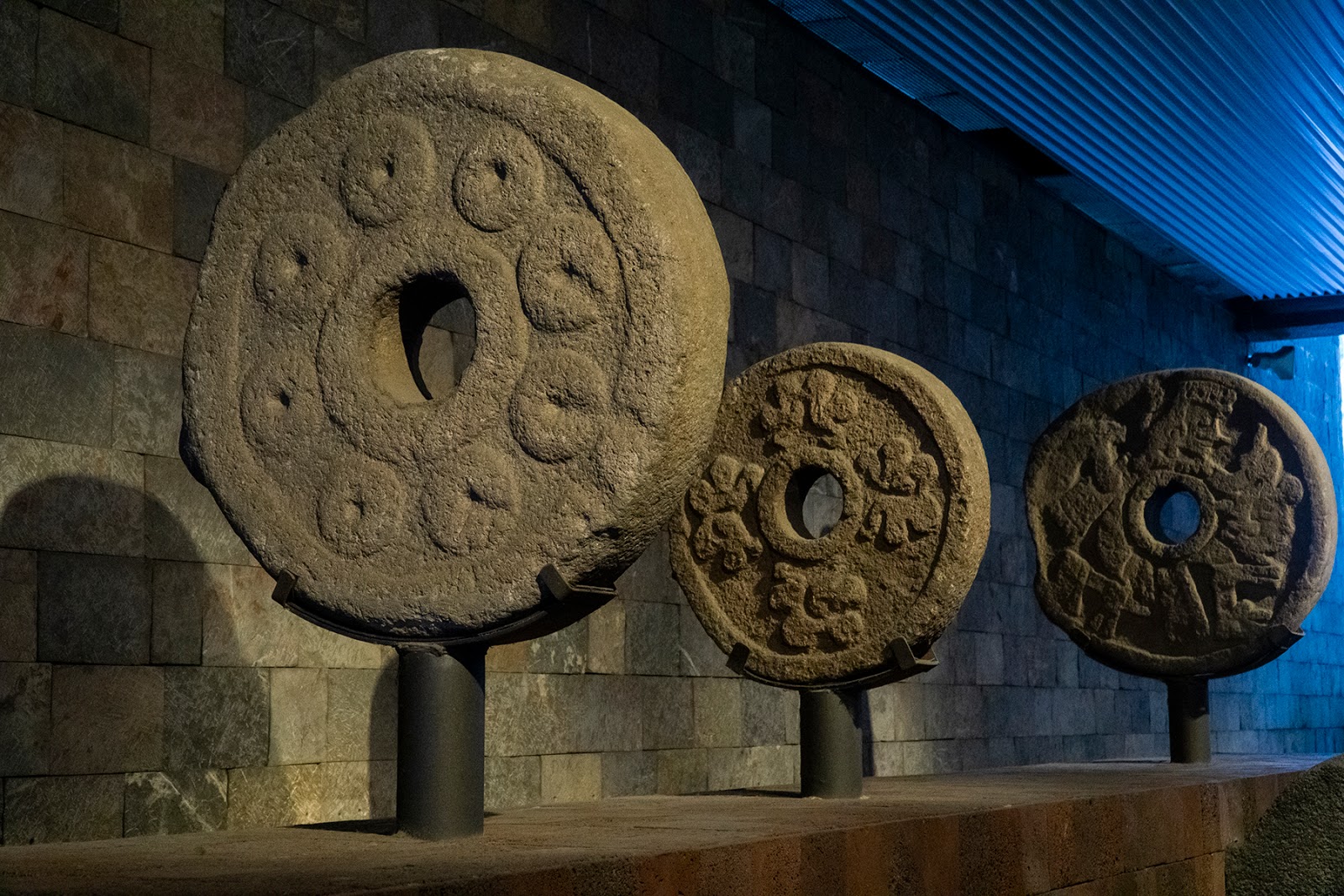
Ball Court Hoop, Anthropology Museum, Mexico City (Author's collection. copyright 2019)


Due to their out-lying locations, it is surmised that these two sites were actually trading posts due to their proximity to Chacoan/Mogollon settlements.  Commerce activity in this region was very dynamic during this entire period and shouldn’t be thought of as locked containers passing customs checks with end user certificates for verification or even clipboards with inventory lists received via Email.  It was more like the old town five and dime store owner who was aware of all facets of inventory and supply/demand in his head because he was familiar with every nuance of change that his town and customers experienced.  

                          
Ball court marker, Teotihuacan (Author's collection. copyright 2019)
Trade continued like this for a long time but in about 1,000 AD things began to change; that is when social complexity changed in the Sinaloa region of today’s Mexico: the southern end of the Chihuahua Corridor.  The Chalchihuites were the northern most representatives of Mesoamerica culture and between 950 and 1150 AD their seat of power was the city of Zape in northern Durango.

Ball court hoops from Teotihuacan, Anthropology Museum, Mexico City (Author's collection. copyright 2019)


Monday, October 28, 2019

War by Other Means, Part One


    Mesoamerica is a word that conjures images in the minds of westerners.  Images of colourfully decorated priests cutting the hearts out of victims atop perfectly built stone temples, the victims' blood pouring into cups via specially prepared troughs.  Images of a society girded for war while perfecting their concepts of astronomy and time and images of pyramids mysteriously abandoned for all time by their creators. 

Native dancer, Mexico City, Mexico (Author's collection,  copyright 2019)

Yet the truth is that the word is a mis-nomer.  It leads the listener to think of a single place, society or culture but Mesoamerica was anything but that.  For millennia, the region, which stretches from modern day Mexico to Costa Rica, was comprised of a conglomeration of city-states and a few empires, each of which rose and fell like all the other societies before and after them.  They traded far and wide with as many other tribes as possible but fighting amongst them was more often than not the norm.  Mayan, Olmec, Toltec, Chalchihuites, Mixtec, Zapotec and Teotihuacan to name a few, there were some who’s names aren’t even known.  One thing that is known is that commerce was a large part of each of these better known societies and commerce is  always dependent upon access to trade routes.  


Jackson Step, part of the Chacoan road system (Author's collection copyright 2019)

Two of those routes led from modern-day northwest Mexico into modern-day southwest United States.  The Hohokam Society of today’s American state of Arizona sat at the northern end of the Sonoran Corridor which ran along the Sonoran Coast and linked them to their suppliers, the Guasave culture.  The Ancestral-Puebloans (of Chaco Canyon) and the Mogollons sat at the northern end of the Chihuahua Corridor which wound along the eastern slopes of the Sierra Madre mountain range.  Each of these corridors allowed for the diffusion of Mesoamerica goods (and culture) to flow into the southwest.  Close examination of these circumstances reveals that ancient trade agreements were just as fragile as they are today and that trade wars were just as nasty then as they are now. 

Monday, October 14, 2019

Loose Ends, Part One

    Mexico City is known for many things - especially their upcoming annual celebration of Día de Muertos, but the city’s involvement in the closing chapter of the Bolshevik Revolution is little known.  It was on a sticky afternoon in August of 1940 in the now stylish borough of Coyoacán that the Bolshevik Revolution wrote its final note as the people’s rebellion.  

 Lev Davidovich Bronstein, AKA Leon Trotsky (Author's collection)

     Vladimir Lenin and Leon Trotsky had built the Russian Revolution to empower the Russian people to rise up against their oppressive Monarch, Tsar Nicholas II but their overall idea was to create a system for world-wide revolution - throwing off the "oppressive" cloak of capitalism and empowering the people.  Though the Bolsheviks did a good job of harnessing some of the rampant public discontent extant in Russia at the time, there were many groups actively engaged in subversion in and around St. Petersburg in 1917 and Leon Trotsky was a leader within one of those socialist/communist groups, the  Menshevik’s.  Because of mounting turmoil, Tsar Nicholas abdicated in March of 1917 and an interim government was set up to try and repair the nation’s economy and social unrest all while fighting World War I.  The spark of public agitation was fanned to flames by groups like the Mensheviks and the Bolsheviks but it wasn’t until the Germans freed Vladimir Ilyich Lenin from one of their prisons and put him on a train back to St. Petersburg that things began to really heat up.  Just before the October revolution, Trotsky joined the Bolshevik party and was an immediate "insider" who went on to be one of the original seven on the first Politburo which led and directed the Bolshevik revolution. From the October revolution, widespread pandemonium ensued and it was obvious that the Bolsheviks didn’t stand a chance of leading Russia into communism.  The Bolsheviks were ardent writers and loquacious orators but their ability to create useful policy AND put it into place was another thing all together and yet, somehow, they survived.

Secretary office in the house of Trotsky, Mexico City. (Author's Collection, copyright 2019)


    To make a long story short, Russia made a separate peace with Germany, a civil war ensued and countless Russian innocents were murdered while inept policies were implemented and overturned repeatedly and the Bolsheviks blamed everyone but themselves for their failures.  As these failures became apparent, the Soviets (the new name for the Bolsheviks) began to rule the people more harshly.  Questions were met with beatings and dissent with bullets.  During all of this, Trotsky continued to rise through the party ranks.

Trotsky's desk, where he died. (Author's collection. copyright  2019)

Monday, October 7, 2019

Globalism in the American Southwest


    We are not the first culture to have and rely upon international trade.  If we feel that way, perhaps it’s because we coined the term “globalism” to reflect our connected global marketplace.  Unfortunately, that is the only contribution we made to global trade.  The spice roads connected China and Europe via Persia and India for thousands of years before an unknown Venetian sailor in a Genoese prison recounted his travels to the East.
    Cultures are only the sum of their societal input regardless of how diverse they may be.  Life in the Roman Empire was completely different depending on whether you were in Gaul or in Palestine but it was Roman life none-the-less.


Pueblo Bonito, Chaco Canyon, New Mexico, USA (Author's Collection. Copyright 2015)

    Perhaps this overview should be applied to the Ancestral Puebloans.  In an attempt to explain the chasm of unknowns associated with their history, today’s scholars are trying to invent their own “Theory of Everything”.  Sadly, they are precluding obvious and significant facts in order to do it.  The largest fact is that the Chaco World conducted significant, long-distance trade not only with their contemporary societies, but also with Mesoamerica and there is evidence of even wider commercial circles.  These Ancestral Puebloans had contact with many external societies and being highly adaptable people, they traded for different goods from different regions: Sea shells from the West Coast, Macaws and cacao from Mesoamerica and copper ornaments which may have come from The midwest state of Missouri in today’s United States.  As we do today, Chacoans used what they could, acquired what they needed and tried to leave a better world for their children.  So, when studying a culture that provides no eye-witnesses and only limited recorded resources, we must be careful not to be fooled by the facts.  Because of this situation of limited resources, we rely heavily upon archaeology and, to a lesser degree, the oral traditions of today’s Puebloan tribes and it is imperative that we do not use any single-source of input if we hope to arrive at a viable conclusion. 

Kin Klizhin Tower Kiva, Kin Klizhin Outlier, New Mexico, USA (Author's Collection. Copyright 2015)


    The conclusion is that Chaco Canyon was, for centuries, a vibrant culture diffused throughout the Four-Corners Region of today’s United States that had contact with their contemporary cultures both near and far.  The level of this contact differed over the centuries but left its indelible mark on Chacoan Culture for the rest of time.  Chacoans assimilated many cultural traditions, both good and bad, and, in the end, all these forces - internal, external, cultural, socio-political and environmental - forced Ancestral Puebloans to abandon their homes and disappear into time.

Pueblo Bonito, Chaco Canyon, New Mexico, USA (Author's Collection. Copyright 2015)


Monday, September 23, 2019

Passage of Time


This week I have had no time to look at the history of anything as I’ve been too busy walking through the history of Egypt.  Please enjoy these images in lieu of any words.


Pyramids of Giza (from Author's Collection. Copyright 2019)

Pyramids of Giza (Author's Collection. Copyright 2019)

Pyramids of Giza (Author's Collection. Copyright 2019)

Saqqara Pyramid: the oldest building in the world (Author's Collection.  Copyright 2019)

Necropolis of Saqqara (Author's Collection. Copyright 2019)

Pyramid of Unas at Saqqara (Author's Collection. Copyright 2019)

Hieroglyphs inside Pyramid of Unas (Author's Collection. Copyright 2019)


Monday, September 16, 2019

Genetic Encoding, Part Two of Two

  In fact, in Egyptian history it is rare to find changes that were instigated by the masses.  External factors were almost always coming to bear on the people of this great country and those factors were typically “top down” changes.  

Cario in the morning
(Author's Collection, copyright 2019)

Adjusting to these changes was for them to deal with as leaders are rarely concerned with (and quite often unaware) of the daily difficulties that are enacted when they flippantly decide to do something.  Self-righteous Pharaohs, impetuous rulers, colonial oversight and exploitation by empires are but some of the ancient examples of difficulties that the average Egyptian had to contend with but the recent past isn’t any better.


Fast Food in Cairo's Market
(Author's Collection, copyright 2019)


    Recent political turmoil has built upon decades of questionable national level decisions which have created a poor educational system and created mass poverty (average annual income is 6,700USD).  A by-product of this situation is growing sectarian violence and increasing economic instability- the uneducated can’t be expected to make informed decisions or develop insightful philosophical points of view.  


Streets of Imbabah
(Author's Collection, copyright 2019)


In response, the Egyptian Government recently de-valued their currency (Egyptian Pound) and made severe cuts to public subsidisation/aide programs.  This was all in an effort to qualify for a large loan from the International Monetary Fund (IMF) which the Egyptian Government hopes will stimulate the economy before the more impoverished segment of society is crushed.  Does Egypt (or the world) really need another lane in the Suez Canal?


Egyptian Museum Entrance
(Author's Collection, copyright 2019)

Through all of this, as they have for millennia, Egyptians continue to adjust and compensate for the external factors pressing on their efforts for a better tomorrow.  Without considering all these historical factors, Egyptians live their lives and try to adapt to the radically changing socio-political and economic landscape; doing the best they can before the next change is forced upon them without their consent.  As though adaptation and adjustment have been imprinted in their genetic code.