Showing posts with label Rome. Show all posts

Monday, February 10, 2020

Feats of Engineering or Imposition of Will?

  Flying over the Rhine River last week I was struck by its size.  It is truly a massive obstacle, one that slowed the Allied advance into Germany only 70 years ago, despite their modern technology.  They were forced to be creative in their river-crossing techniques and even had to resort to boat crossings in some places.  
    Caesar writes that in 55 BC boat crossings were beneath him, so he had his field engineers build a forty foot wide wooden bridge across  the Rhine in ten days - including the time to fell the trees!  Scholars believe this crossing to have been accomplished somewhere between Andernach and Coblenz where, today, the river is between 250 and 300 metres wide.


Author's image of a drawing from Caesar I Gallic War, Loeb Classical Library, 1917.
     
    The Roman engineers devised a method of re-enforcing the supporting timbers using the strength of the river’s current while topping it with a paved road as well as building defences upstream to deter and defend from waterborne attacks.  Caesar doesn’t mention any attacks from the Suebi Tribe - whom he invaded Germania to subdue.  In fact, Caesar never engaged them in combat.  He conducted punitive raids against their villages and signed treaties with their enemies: demonstrating that the Rhine was not Rome’s northern border.  So after 18 days in Germania, Caesar decides his goals have been met, whence, he crosses his bridge back into Gaul and destroys it behind him.  
    It is this willingness to do the impossible which made Rome great.  Whether involved in 360 degree siege/counter-siege warfare - as was the case at Alesia - or imposing their will on rebellious natives; Roman technology, accompanied by Roman courage built the world’s largest empire to date.

    Looking at today’s bureaucracy riddled command structures one must wonder what an unencumbered will, like Caesar’s, might impose on a less committed foe.

Monday, August 26, 2019

If it Ain’t Broke…


    I am neither an architect nor an Engineer by trade.  I am a natural tinkerer and have spent most of my life breaking my toys, so I have an appreciation for how things are made and what it takes to make them.  As such, I spend a lot of time noticing differences in construction: things like the pathetic stitching on the snaps of Hasbro’s G.I. Joe camouflage fatigues the last year they were made.  Incidentally, I still have a set of those cammies from their first year of production.  Bombproof!
    This is all a way of saying that newer isn’t necessarily better.  Last week I was watching a re-run of a World War Two documentary in which Germany invaded France by running around the Maginot line.  While discussing river crossings and their importance to military operations, historic film reels were played showing a German tank crossing a makeshift bridge; one hastily constructed from little more than timbers laid across numerous small boats.  This bridge struck me as familiar and I began to sift through my library for references to this construction as it seemed out of place in this German war footage.

Screenshot of bridge by author

   I worked backwards in time and was consulting J. Caesar’s The Gallic War without finding my bridge, so I looked further back in time.  Finally, I found it.  The description went something like this:  
    
Many boats (654) were placed side-by-side and facing into the current while cables were used to secure them to the shore and the individual bows were anchored up and down stream to keep the boats in line relative to each other and adding more stability.  Boards were then placed between the boats and over the cables to connect them while brushwood and soil were placed over the boards to create a walkway and a more even surface after which a handrail was placed on either side to keep soldiers and beasts of burden from falling in. 


Author's image of a bridge in Afghanistan taken from The Histories

    This resource that listed my bridge was actually Herodotus when his Histories were describing how the Persian Empire invaded Greece.  Xerxes used this bridge type to cross the Hellespont in 482BC (circa).  This narrows is approximately 1240 metres (1350 yards) of the most difficult waters in the world.  This successful iteration was actually the second effort.  The first had ended badly for all: the engineering supervisors were beheaded and the waters of the Hellespont were flogged with 300 lashes while being subjected to verbal abuse for being disobedient.  


Author's image of a sketch from The Histories  


So, in 2019 I saw a film from 1939 which spoke about how technologically advanced the German Army was and how incorporating this technology gave the Germans a battlefield advantage.  Yet in this film, our twentieth century technological genius’ used a bridging technique from 2,421 years earlier.  Perhaps part of their genius was their ability to recognise when something works well.

Monday, August 19, 2019

Greek Fire


    Since the dawn of time man has been competitive.  Perhaps that is what has set him apart from the rest of the animal kingdom: Faster, farther, better - regardless of the endeavour.  This is especially true in warfare.  More efficient means of vanquishing the opponent has always found an audience: and so it was with Greek Fire.

    In the early days of the Greek city states and of the Roman Empire, the use of incendiaries in combat was rampant and the unpredictable nature of Greek Fire made it as hazardous to the employer as it was to the intended victim.  Yet, the ability to throw fire from one point to another in a focused and directed manner was very desirable, so pyro-masters kept refining the process through trial and error.  Finally, in about 668AD, a Greek refugee from Syria arrived at Constantinople with a proven recipe.  By 672, Kallinikos, as our Greek was called, had perfected his delivery technique and was using it to defend the Eastern Roman Empire against invaders.  Legend has it that this version could set water on fire and actually burn underwater.  

Image of a 12th century manuscript (Author's collection)
    All mythology and nonsense, right?  Except that napalm and white phosphorous fit these descriptions and were used to great effect during the wars of the twentieth century.  Throughout time there were other munitions that created races to develop and acquire regardless of the cost in dollars or humanity.  The atomic bomb is an excellent example of today’s Greek Fire as the centre of the mushroom cloud over Hiroshima, Japan reached five thousand degrees centigrade.  Add to that the fact that the second bomb (made of plutonium, not uranium) was so unstable that it had to be tested in the New Mexico desert prior to being dropped on Nagasaki and due to the arms race (both before and after) created by its introduction we see many parallels with Greek Fire. 

    Even today, the search for the proper recipe continues.  In early August 2019, there was an explosion west of Archangel, Russia and, subsequently, the town of Nenoksa was evacuated and all this was conducted under a veil of mis-information and retracted statements by the Russian Government.  What ever their cover-story may be, the most likely happenstance is this: The Russian military was testing a Skyfall missile (a nuclear missile powered by a nuclear reactor) that went awry.  The best bet is that its portable nuclear power station melted down in a smaller version of the Chernobyl, Ukraine tragedy.  Most certainly, the power station was one of a new offering by the Russian firm Rosatom.  Rosatom stated last year that they envisioned their new portable reactors being used in a fleet of nuclear-powered ice-breaking ships in support of Russia’s efforts to open (then dominate) the Northern Sea Route: thus connecting the Atlantic and Pacific Oceans via the Artic.

    Keep in mind that through all of this, Russia has no overt enemies and the only international enmity directed towards them is because of their meddling in external, sovereign affairs.
Close-up of the above manuscript (Author's collection)


Is this the fallout from today’s Greek Fire?

Monday, August 12, 2019

From the Ashes of Empire

"To the Strongest"

    With these last words, in response to the question, who will rule your kingdom, the empire of Alexander the Great began to crumble.  Despite all his hard work, he failed to plan for the earthly immortality of his actions and ensured that the fractious and internecine nature of Macedonian politics would continue.  His kingdom was quickly divided into four sections: the two most famous being the Seleucid Empire (Mesopotamia and Persia) and the Ptolemaic Dynasty (Egypt and Palestine).  
    
Modern day view of Hydaspes Battlefield, Pakistan (Author's collection, copyright 2019)
    Of these two, the Ptolemaic lasted until the death of Cleopatra in 30 BC whereupon it was absorbed into the Roman Empire.  Cleopatra committed suicide with a viper (as the story goes) and her palace was eventually overtaken by a rising sea and lost to time.
    In 1996 Archaeologist Franck Goddio discovered the palace five metres underwater in Alexandria's East Harbour and this set off a frenzy of activity in the region, the repercussions of which we are still feeling today.
Greek Coins (circa 330BC) on display Lahore Museam (Author's collection, copyright 2019)
    Perhaps the greatest lesson in all of this is the employment of proper preparation.  Egypt's Alexandria became an immortal city through Ptolemy's hard work after Alexander's death, yet he was only in charge of Alexandria because Alexander failed to plan.  The details of ancient Alexandria have been lost to time because of the destruction of its library.  This library where all the knowledge of the ancient world was centralised for the ease of access and distribution.  Yet a single, unplanned event wiped it out and the tumultuous subsequent historical events (including a sea that rose about eight metres) ensured that we today aren't sure about much of anything with regard to ancient Alexandria.
    Some might say, "That could never happen to us, we have the internet and all information is distributed and accessible worldwide." That sounds great as long as there is electrical power and the servers aren't compromised.   A recent nuclear explosion near Russia's White Sea was an unplanned event that is depriving inhabitants of electricity for the foreseeable future and I'm sure a nuclear explosion is harmful to servers.  
    To take a lesson from a long series of mistakes.  Let's not put all our eggs in one basket.


Monday, July 15, 2019

Alexander Who?

    Alexander the Great was the master manipulator of his own image but time has been more than kind by nurturing and honing his reputation as well.  Plutarch, Arrian and Rufus each used existing resources to write their biographies of Alexander which are denied to us by time.  These original resources were written by Alexander’s contemporaries and undoubtedly contained vital information, both good and bad,  that we will never recover.  We have a good idea of their contents thanks to our “intermediary” biographers but that means we also have to access that information through their filter; in short, their “why” for writing.  No one has ever written for the sake of writing - they always have a reason: as in all art forms, there is a muse.  Our intermediary biographers were Romans and the Romans were, above all things, organised.  Rome stopped at nothing in order to systematically arrange a society that supported the state completely, so the Empire was consolidated and safe.  Additionally, the Romans built things to last.  Don’t believe me? Just look at the width of railroad tracks in the United States today and the liturgy in any Christian church.  The width of wagon tracks and the standardisation of Christianity through the First Council of Nicaea are all products of Roman regulation that we feel the effects of today.  So perhaps our interpretation of Alexander the Great has been regulated too. 

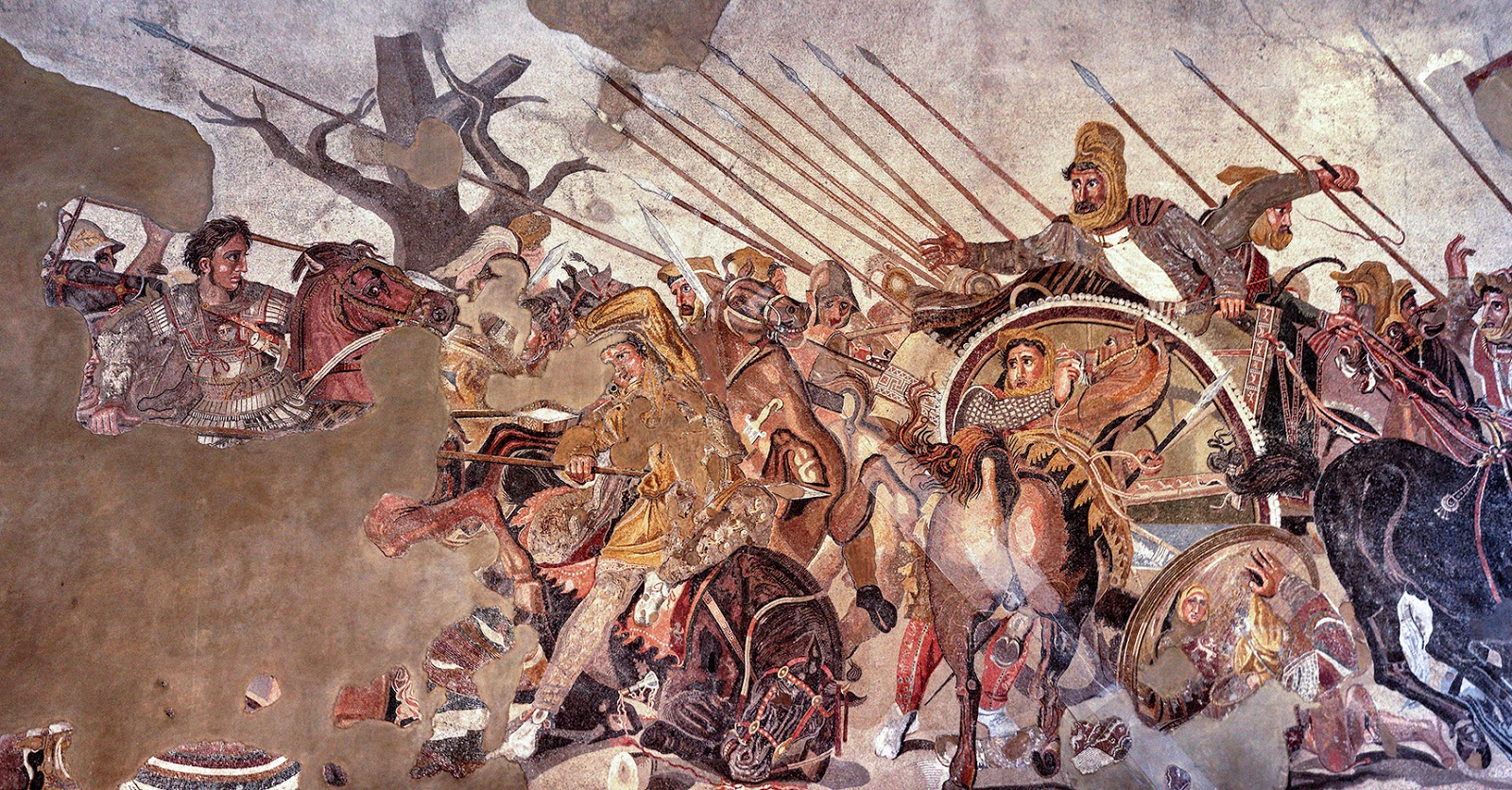
Mosaic of Alexander at Issus (Author's collection copyright 2013)

Arrian - 2nd century AD: Roman citizen by father’s status as a Roman Administrator. 
Quintis Curtius Rufus - 1st century AD: borne into one of the original Roman noble families.
Plutarch - 1st century AD: a naturalised Roman Citizen.

    As shown above, each of our biographers had a reason to write for Rome. Whether to uphold a family name or ingratiate themselves to the Republic, their writings could easily mean their demise if not presented properly.  The Pantheon of gods was still the religion of state in the second century AD so any presentation would need to include references to this in order to be legitimate and that is exactly what we find in their writings.  Why else would obscure references to the god’s favouring Alexander be included in their accounts.  After the battle for Xanthos in Lycia (modern day Turkey), an inscribed tablet was found in a nearby spring.  This ancient tablet apparently told of a prophesy of doom for the Persians at the hands of the Greeks - which was meant to be Alexander and his army due to the timing of its discovery.  Whether in Greece, Turkey or Libya, we are told that Alexander actively sought out oracles or tried to full-fill prophesies through his actions.  He was deified by the Egyptians and his ascension as the Persian King brought with it a hint of godly status as well, because the house of Cyrus was descended from gods.  Never mind that Alexander himself was called the Son of Zeus and had long claimed Heracles as an ancestor.
    Why then, would these seemingly obscure references to exaltedness be included in the biographies by our Romans?  If they were writing for Roman knowledge alone, these items would have been left out as the drivel of ancient and unsophisticated historians, yet, they were included and perhaps amplified in importance.  The answer lies in human nature.  Our biographers were trying to ensure their status within a very forgetful and ungrateful Roman society by producing comprehensive works that not only entertain and inform but also teach lessons in a moralistic manner.  
    In these works, Alexander was a god on earth.  He conquered most of the known world.  He survived countless battles and court intrigues by the dozen.  He was impetuous and emotional, yet brilliant and benevolent.  Capable of great chivalry and even greater acts of violence.  When presented with problems, Alexander met each one head-on with a singleness of purpose that always saw him through successfully.  To our biographers, Alexander is, in short, Rome.  
This would not have been lost on Roman audiences reading these works and the more subtle message therein would also have been received well.  The morality tale spoke of this great individual who traveled too far from home too fast.  A man who, despite all his perfection, was seduced by foreign ideas and customs and became, increasingly, distant from his true purpose; living hedonistically as savages do.  He was eventually reminded of his purpose by his countrymen but by the time he realised his errors and tried to return, it was too late.  He could never go home.
    This part of their tale, above all, was their greatest legacy for Rome.  An inverted roadmap for personal and empirical comportment by highlighting the negative aspects of failure to comply.  In doing this, our authors have ensured their place in history not by writing great works on a historic general, but by creating a hero for all time who was old enough to win the world and young enough to lose it.

Monday, July 8, 2019

Keeping the Media at Bay

Image of Alexander's Sarcophagus(Author's collection)
    What to do with a precocious child who meddles in adult's business?  Today, I'm not sure but I know in my childhood, an immediate and severe beating would ensue coupled with some sort of long term misery was the prescription.  In fourth century BC Macedonia, he was made a king.  At least that's what happened to Alexander, son of Phillip II.  Although this precocious child went on to conquer the known world he was still meddlesome in his youth and erratic in his behaviour.  Of all the topics Aristotle taught Alexander, it seems that he learned one lesson very well; how to control his image with the public.
    We know from contemporary biographers that he was creative in his reports back to Macedonia but this is all second-hand speculation as not one of those biographies is extant today.  We are forced to rely Arrian and Plutarch and Rufus - all of which were writing hundreds of years after the fact but cited these originals as their sources.  Could it be that today's generals could take another, more subtle, lesson from Alexander's playbook?
    By all accounts though Alexander was a master of perception management and it would seem that this has extended through the years.  Despite many indicators that Alexander was impetuous and emotional, his reputation today is that of a great leader who managed his meagre resources superbly.
    This was achieved by limiting the exposure outlets that were available to the public and controlling them completely - Callisthenes (an embedded biographer) didn't make it home alive.  Centuries later, the worst that chroniclers could do was to highlight the ire of Alexander's troops over his tendency to "go native" but not one of these writers has acknowledged the need for Alexander to ingratiate himself to the recently defeated and still restive native populations that surrounded him and his small band of Macedonian soldiers.  Additionally, our writer's have never been placed in perspective themselves; they were spinning a moral tale for a specific audience in their own times.  This story became cautionary over time towards their own leaders - An intrepid westerner is seduced by the vices of the East which eventually kill him.  In other words: don't be like Alexander, cling tightly to your Roman values while serving the Republic in far-flung corners of the realm (their audience was Rome).  It would seem that the media has been a tool of the ruling elite for quite some time.

Alexander against Darius III at Issus. A 1st century BC floor mosaic from Pompeii, Italy. (author's collection copyright 2013) 
    It is readily apparent to me that today's media - in their self-driven 24/7 need to produce information for and grab ratings from an lethargic and saturated audience - has dug deeper into our military's conduct than they need to.  Our general's today should take a lesson from Alexander and keep them at bay - feeding them the relevant stories for public consumption instead of allowing these embedded reporters to dig up the worst and most irrelevant rumours to report as facts to an already naive public who doesn't understand what war fighting is all about.