Showing posts with label commerce. Show all posts

Monday, March 16, 2020

A Land of Myth, Mystery or Men?

 So if this Golden Fleece thing was just a smash and grab job, why is Georgia so important?  

    It would seem that Georgia has been a crucible for mankind since before we were mankind.  As related in an earlier edition, multiple Pre-Homo Sapien specimens have been found in the region of Dmanisi.  Under present anthropological understanding, the importance of this find would have been meaningless - or worse, mis-interpreted - were they not found in such close proximity to each other, as in Dmanisi.  As I understand it from reading in the Georgian National Museum, this has never been found before.  Why were our earliest humanoid species discovered together outside Africa in Georgia?  A distance of at least 1,600 kilometres (1000 miles).  Could they have been at the meeting with God (entry 24 February 2020)?


Skull, Homo-erectus(Author's collection)


    As noted in the last several entries, evidence of contact between Hellenic Greece and western Georgia was effected in approximately1200BC through Jason and his Argonauts but their knowledge of the Golden Fleece in Greece begs the question: who told them about it?

    In Greek Mythology we encounter Prometheus.  A demi-god of the heroic nature but one that ran afoul of his full-blooded cousins by stealing the secret of fire and giving it to mankind.  For this transgression, he was chained to a mountain top where an eagle pecked his liver out by day and it re-constituted itself by night.  That mountaintop was non other than Mount Kazbegi located in Georgia on the border with Russia along the Georgian Military Highway.  Georgian mythology has a similar character who suffered the same fate named Amirani.  Did Jason return with that bit of information too?


Mount Kazbegi centre image (Author's collection copyright 2020)


    The concentration of unique languages is prolific in the Caucasus as well.  It seems that every mountaintop speaks a different language (not dialect) and most are too old to have an alphabet.  The Georgian alphabet itself is among the oldest in the world.  Interestingly, mythology comes to the rescue here as well.  Local legend has it that while distributing languages to the world’s people, God placed all the languages in large panniers and mounted them on a donkey for easier transport.  While walking over the Greater Caucasus Mountains, the high, jagged peaks tore the bottom of the panniers and many languages fell across that small area before the holes were patched.


Georgian village in Svaneti Region of Georgia
(Author's collection copyright 2020)


    Life in the Caucasus has never been easy and it takes a hearty breed to survive.  It stands to reason that anyone standing out in a crowd like that would be legendary in their exploits.  This holds true for Georgia.  Many larger-than-life characters have existed throughout time.  King Vakhtang Gorgasali was said to have been deer hunting one day in the fifth century AD.  He was in an unfamiliar region, a bog-ridden area next to the Mtkvari River when he wounded a stag with an arrow.  King Vakhtang chased the wounded deer into the bogs where it disappeared from site through the morning mist but he heard it fall into the marshy waters.  So sure was he that the animal was dead that he ran forward unprepared, only to see the stag emerge from the waters unharmed and run away unscathed.  Bewildered by this, he investigated the reason for it and is credited with discovering the curative waters which gave rise to the city of Tbilisi: the capital of today’s Georgia.


Hamams in Old Towne Tbilisi (Author's collection, copyright 2020)


    Later, after a war with the Ottoman Empire, Tsarist Russia was trying to “Tame” their recent acquisition called Georgia and many a hard man was drawn to the Caucasus to test his mettle and make his fame.  In fact, a large body of Russian literature is linked to the wars of oppression in the Caucasus and one of the greatest insurgencies ever fought took place there: driven by the unbending will of its best known leader, Imam Shamil, an Avar from today's Daghestan.  With drive in mind, history would soon recognise another Georgian: Ioseb Dzhugashvshvili.  We remember him as Josef Stalin and he killed millions of people trying to impose his will on the world under the guise of communism.  


     Perhaps, unbending will is the true mystery of the land God reserved for himself.  Each individual I met there, over decades of interaction, was a force to be reckoned with - men and women both.  So if the region's mystery is, indeed, the unbending will of men, Caucasians most likely created the circumstances from which myth emerged and with this en-ending supply of wilful people, the Caucasus has remained prominent in the development of mankind since the dawn of time.


Monday, March 9, 2020

So what really happened?

      Legend tells us that a generation before the Trojan War, in ancient Thessaly, King Pelias stole the throne from his half-brother King Aeson.  In doing this, Pelias made a dangerous enemy in Aeson’s son, Jason, but sent him off on a quest to the empire of Colchis (modern day Georgia).  If completed successfully, this quest had the ultimate pay-off - Jason would be crowned king of Pelias and if he failed, Jason would pay the ultimate price.  To this end, Jason surrounded himself with some of the greatest heroes of the day and it was these heroes and their exploits that grew into legend.  This is the story first related in the third millennium BC by Apollonius of Rhodes entitled, The Argonautica.
All legends are based in truth and this one is no different.  It would appear that wealth and nation building were paramount to would-be-kings even thousands of years ago.  All empires need a financial reserve as well as sustained revenue and it was well known that Colchis was rich in gold. What made them so rich was their particular methods of acquisition.  The Rioni River and its tributaries were populated with wooden vessels outfitted with sheep skins that would take advantage of the rivers’ currents to sift the gold particles as they flowed out of the Greater Caucasus Mountains.  It is not hard to believe that over the millennia, such a simple but revolutionary technique would become the myth of the Golden Fleece.

Colchian earrings - circa 1st millennia BC. (Author's collection, Copyright 2020)

If true, it would seem that the real reason for this exploit was the acquisition of technology - not a simple smash-and-grab robbery.  Think of it like the old adage, “give a man a fish and feed him for a day.  Teach him to fish and you’ve fed him for life.”  Is that the real reason Jason surrounded himself with demi-gods?  How else could one expect to acquire such sensitive information?  

Jason knew that he had to have every skillset possible in order to have any chance of success.  

       Historians and storytellers differ in their passenger list aboard the Argo but generally agree that 50 crewmen were necessary and among the crew there are a few names that always appear: Heracles, Castor, Pollux, Peleus and Telamon.  It was these men, with their varied specialties and capabilities, who had been brothers in arms for such a long time that made Jason's success nearly a forgone conclusion.

Necklace from Vani, Georgia - circa 1st Millennia BC. (Author's collection.  Copyright 2020)


So we see that financial stability and corporate espionage were most likely the basis for the exploits we call the Quest for the Golden Fleece and in an effort to ensure success, Jason surrounded himself with men capable of a variety of skills - skills like; cunning, strength, intelligence and endurance.  Skills that may or may not be required for success but whose lack, when needed, would ensure failure. 
        Yet, in the end we see that for all his planning, preparation and coordination, it was an unforeseen capability that won the day for Jason: magic.  The magic of love when Medea fell for Jason and agreed to help him steal the Golden Fleece from her father, King Aeetes of Colchis.

Bracelet from tomb in Vani, Georgia - circa 1st Millennia BC.
(Author's collection. Copyright 2020)


Monday, March 2, 2020

Origins of the Golden Fleece Myth

    In European culture seeking wisdom - especially hidden knowledge - finds its reflection in the symbols associated with gold: the Golden Fleece, the Philosopher’s Stone and the Holy Grail.  For all the qualities it embraces - this eternal and most noble of metals - gold was recognised as the metal of the sun.  It has become the foremost physical medium for the expression of men’s spiritual endeavours and the scientific knowledge about working gold is seen as one of the revelations of wisdom itself.

Detail on a 18th century BC cup from Trialeti depicting a religious ceremony.
(Author's Collection. Copyright 2020)

  The two phenomena: gold and knowledge, especially the knowledge of gold amongst the Colchians, were the genesis for rationalising the myth of the Golden Fleece.  It was this Golden Fleece that was the main goal of the first long-distance maritime adventure in mankind’s recorded history.  The Greek philosopher and mythographer Euhemerus went so far as to interpret the Golden Fleece as a technique of writing in gold on parchment or a book written on skins which describes the method of obtaining gold by means of chemistry.

Fourth century BC example of Colchian goldsmith techniques.
(Author's collection.  Copyright 2020)


  Why is the myth of the Golden Fleece - which emerged from the culture of classical antiquity and pursued its life in the alchemy of Medieval Europe - connected to Colchis?  The answer to this question may be found in Greek written sources that mention Colchis as “rich in gold”, similar to the cities of Mycenae, Sardis and Babylon which were all famed for their wealth.  Perhaps more significantly, the answer lies in the knowledge of obtaining, working and using gold for high spiritual goals - the wisdom that was continuously refined, preserved and passed down throughout the centuries in the territory of Colchis and the entire country of Georgia. Today we witness the demonstration of this wisdom in the golden artefacts found all around the country we call Georgia and we continue to re-discover these techniques and knowledge through our study of these pieces of history.

Colchian fourth century(approx) plaque depicting bull, boar and lion.
(Author's collection. Copyright 2020)


Monday, February 24, 2020

Why Colchis?


"The wealth of the regions about Colchis, which is derived from the mines of gold, silver, iron and copper, suggests a reasonable motive for the expedition of Jason."

Strabo, Geographica, 1.2.39


Excavation at Vani, Georgia - Colchian city.  (Author's Collection. Copyright 2020)

    In today’s “age of reason”, we use science to explain our world.  In the previous world it was religion that explained how things worked and before that, it was myth that gave reason to our world.  

Strangely, even today, the Caucasus is a world of myth.

    Myths and legends carry a powerful message through time - how the tellers of these tales view themselves.  Every tribe under the sun has these stories - each rooted in a time too distant to remember and each of them fascinating.  Yet all of these legends have one thing in common - they stand the test of time.  We, as people, are inextricably bound to the past: it makes us what we are today and shapes what we will become tomorrow.  One could even say that without the past there would be no future.


Waterfront in Batumi, Georgia - eastern Black Sea (Author's Collection. Copyright 2020)

    Strabo describes the wealth of an ancient civilisation as the plausible impetus for one of history’s most enduring myths but perhaps the wealth described by Strabo above can be explained by an even older Georgian myth.

In the beginning, God created the Earth and all its people.  He then asked all the people to attend a gathering so that he may parcel out all the lands of the Earth to them for habitation.  On the appointed day, all the peoples of Earth gathered and received, from God, what we call today their ancestral homelands.  Conspicuously, one group of people was not present, but God went ahead and gave the lands out as gifts to those that were.  Once all the lands were dispersed and the people departed from the gathering, the one missing group arrived.  God said unto them, “My children, I’m sorry but you are late and no land is left to be given unto you as a home.  Where have you been?”  The group replied to God that they had been feasting and toasting God’s good name and his benevolence and, according to their traditions, could not stop the feast in order to attend his meeting.  They apologised profusely but re-iterated that they were late because their particular form of worship had deterred them from arriving on time.  So the Lord spoke to this group of people and said, “You are a genuine and pious people who deserve a good homeland, as such, I will give unto you the place on Earth I had reserved for myself: Georgia.


10th century AD (approx) ruins overlooking Rioni River 
from Bagrati Cathedral in Kutaisi, Georgia
(Author's collection. Copyright 2020)

    God’s reservation of Georgia as his own refuge could be an acceptable reason for us to believe in the incredible mineral wealth of the region and through time, this could have manifested itself in the great wealth of the empire of Colchis.  This empire on the eastern end of the Black Sea in today’s Georgia was the target of Jason and his boatload of adventuring heroes.

Colchian anthropomorphic figures in main sqaure fountain. Kutasisi, Georgia
(Author's collection. Copyright 2020)


Monday, February 3, 2020

Time and Patience: the Most Powerful Warriors. Conclusion


    Through all these examples we see that sky watching played a large part in the daily life of Ancestral Puebloans.  The only question is, why? Why was so much effort put into building these great houses with so much care and to such exacting standards?  Why were tens of thousands of trees brought from as far away as 100 kilometres (62 miles) without the aid of animals or the wheel?  Why does it seem the mid-twelfth century was a dividing line in Chacoan culture?  Remember, it was prior to 1150 that the south/southeast (S/SE) orientation was predominant in local architecture and after that cardinal alignment took precedence.  During this same fluorescence period calendrical stations seem to have become very important but they were typically located on sites important to their ancestors.  If that weren’t enough, it seems Chaco Canyon itself may have been occupied due to its alignment with the 19 year greater lunar standstill through its southern mesa topography.  

Tower kivas (gateways to new worlds) in Kin Kletso Great House (Author's collection, copyright 2019)

    This demonstrates the great value Ancestral Puebloans placed on commemorating the cycles of the sun and moon.  Chacoans built the azimuths of sun/moon rise and set, its mid-points and extremes into their architecture on micro and macro scales.  Over the centuries this reverence for time became heirophany and, therefore, impossible to ignore but not impossible to walk away from.


Clusters of kivas inside Pueblo Bonito (Author's collection, copyright 2019)

    All these deliberate activities help to integrate the canyon into a meaningful unification of heaven and earth - but this only brings us back to why.  Why go to all this trouble?  We can see the organised and predictable nature of  Chacoan worship and how it lent itself to creating large festival opportunities: most likely the backbone of a vibrant economy.  This economic well-being was probably based on the commerce created by the well planned arrival of pilgrims attracted to these rituals.  These markets and fairs would have been large enough to allow the Chacoan system to become a clearing house for not only a variety of goods, both foreign and domestic, but also ideas and ideologies, both political and social; all of which would have helped shape the Chacoan world.  This well-organised system would have created political stability for the Chacoan elite and so it was imperative that they remain relevant to their population in order to stay in power.  Its not hard to see that the introduction of new traditions and the physical changes associated with them may have been one manifestation of this quest for relevancy that we can see today.  


Monday, December 2, 2019

Time and Patience, the Most Powerful Warriors. Part Two


    While writing notes on southeast orientation and Cardinal points, I realised that I must address some basic facts and ideas as a precursor to understanding the Chacoan astronomy/architecture nexus.  
    Time in our world is created by two activities; the spinning of the Earth and the Earth’s rotation around the Sun.  Due to the former we have sunrise and sunset (the time of day) and from the latter we enjoy the change of seasons (the time of year).  Through these two types of time, the sun weaves its way across our skies in specific, observable patterns and it was these patterns and conditions which were closely observed by the ancestral Puebloans and became intrinsic to their very existence.
    Through the migration vignette from part one we see that these ancients understood the concept of direction, even if they didn’t have a word for azimuth, declination or Altitude.  As proof today, we have their repeated use of specific directions in their architecture over centuries of building.  This could have been easily accomplished through the use of a gnomon.  The gnomon is a simple tool for determining direction/time through observation of the sun’s movement and was first developed in Babylon though examples exist in the ancient world from China to Peru.


    A gnomon is built by placing a straight stick vertically in level ground and marking the location of the stick’s shadow on the ground through the course of the day.  This will quickly reveal the Cardinal directions and the device is eerily similar to the star tracking “compass” stick described in our migration myth from part one.  With a little ingenuity, this device can be a mobile compass as well.  To employ it one has to first determine the desired direction of travel.  Runners are then sent towards that direction and in the opposite.  These runners merely determine a straight line path through the gnomon itself and begin movement in the desired direction - always traveling in three parties and always re-evaluating their direction using the previous two points and terrain references prior to advancing.  If the party becomes lost or unsure, they merely stop for a day, set up the gnomon, verify the directions and begin again.
North wall of Aztec West great house which is aligned with summer solstice sunrise
(Author's collection. copyright 2019)
    Through close observation over time, a gnomon can also determine the azimuth of the equinoxes and the solstices.  When this began to happen, our ancestral Puebloans were determining annual calendars through the sun’s predictable nature.  Every March and September 21, the Sun rises and sets on the East-West meridian and its declination (distance from the Equator to the Poles measured in degrees) is 0 out of a possible 90 degrees.  Additionally, the gnomon can track the sun’s behaviour through its Winter and Summer Solstice declinations which are a positive or negative 23.5 degrees depending on the time of year.   The gnomon can also determine the altitude of the sun, track the Moon's activity through the full moon cycle and is a carpenter's square.  When this level of expertise is reached, the gnomon is a formidable weapon for nation building.  Horizon calendars can be created and future plans can be made on a grand scale.  Those grand scale plans can be employed to serve specific purposes which can, ultimately, manipulate public opinion and ideals.  

    When utilised in this fashion, our gnomon ceases to be a simple stick in the ground and becomes a sceptre of national power.  In this simple devise lies the power to legitimise rulers by “commanding the heavens” and thus, compel subjects to build organised cosmic cities which create an infrastructure based on that cyclic nature.   Their hard work is rewarded by security, well-planned festivals and markets centred around these cosmic events which stabilise lifestyles, build a vibrant economy and, ultimately, come to define them as a culture.

Specific events tied to an horizon calendar providing anticipatory warning for festival preparation.   (Author's composition)


Monday, November 25, 2019

Time and Patience: the Most Powerful Warriors. Part One


    It has only been in the last 75 years that we have made time a commodity by wearing wrist watches.  Prior to that, those who could afford to wore pocket watches, cumbersome yet useful items once the owner modified his clothing to accommodate storage.  Before these inventions, time was measured in days or months and was seen as an enabler instead of our present day view of time as an external, unseen force showing us our limitations and failures.
    A thousand years ago in the Four Corners Region of the American southwest, time was experienced as a facilitator and an all-encompassing personal encounter.  From the very beginning, these ancient ones were in search of time itself - their mythology stories available to us today claim that in the time after entering this world and before they occupied Chaco Canyon, the Ancestral Puebloans were in a constant state of migration.  They moved in a south by southeastern direction using wooden staffs to measure their travel against a certain star that was only visible at certain times of the year.  Finally, when they reached Chaco Canyon they found a physical manifestation of time on earth.  


Penasco Blanco looking East into Chaco Canyon (Author's Collection, copyright 2019)

    Only recently with our computers and space-based telescopes have we determined what these stone-aged people knew with sticks and naked-eye star-gazing: Chaco Canyon is a calendrical station which is naturally aligned for calculating the 19 year lunar cycle.  To confirm (and ultimately  celebrate) this, Chacoans built redundant observatories for anticipating multiple astronomical dates which were important to them, their religion and their way of life.  Simultaneously, they developed their culture around physical infrastructure that re-enforced their connection to the cosmos.

PuebloBonito from Northern heights (Author's collection, copyright 2019)


    This time-consuming effort required patience in order to be effective.  Patience on a macro scale can be called commitment and it was this commitment to pursue a common vision that fuelled the Chacoan culture through the vicissitudes of the ages and the ravages of environmental difficulties.  During these centuries, they perfected their building techniques and built their concept of time into almost every great house extant as well as their extensive network of roads.  Along the way, Ancestral Puebloans developed a thriving system of “international commerce” by importing commodities that buttressed their religious ceremonies and, ultimately, supported their experience of time.
    In the end, the same patience required to build this manifestation of time undoubtedly had a great deal to do with the abandonment of their monuments because they understood the difficulties associated with building their world as opposed to existing in it.  It was their commitment to this concept of time which prompted them to walk away from their centuries of hard work before they were buried by it. 

 Kin Kletso Masonry (Author's collection, copyright 2019)


Monday, November 11, 2019

War by Other Means, Part Three


    At the northern end of the Chihuahuan Corridor, Chacoans were developing their great house culture and they had also begun inter-pueblo integration between their outlying communities.  By 1150, the increased complexity of society on both ends of the Chihuahua Corridor created new markets and new production centres.  

Tri-walled Kiva at Pueblo del Arroyo, Chaco Canyon, New Mexico. (Author's collection copyright 2019)

    Of course, the increased trade could have had a synergistic effect on social development - especially within the elite classes.  Because of this situation, Casas Grandes, previously an outpost along the Chihuahua Corridor, grew in size and came into direct competition with the Hohokam society’s shell trade.  This shorter and more direct trade route, coupled with new Mesoamerican metallurgical techniques in copper and advances in aviculture practices seem to have sounded the death knell for Hohokam hegemony.  The Chalchihuites provided luxury goods in quantities and at delivery speeds that the Hohokam could not match.  By this time evidence shows Hohokam culture had retreated from its advance posts like Winona and Stony Canyon to their strongholds of Papaguería, the Gila-Salt and Tucson Basins while evidence of Mesoamerica culture amongst the Hohokam diminished.

Homol'ovi Ruins, Winslow, Arizona. (Author's collection. Copyright 2019)

    So it is evident through our discussion here that, prior to 1150 AD, the majority of Chacoan/Mogollon trade conducted with Mesoamerica passed through a Hohokam middleman who absorbed most of the Mesoamerica culture while passing along only the deliverables which is in-line with today’s concept of a middleman marking up any re-sell goods.  Additionally, timelines corroborate the theory that the rise of the Chalchihuites in Zape broke the Hohokam trade monopoly  and forced their retreat from Chacoan western borderlands.  Simultaneously, the timeline reveals that this more direct contact with Mesoamerica culture brought about a rapid decline in Chacoan/Mogollon culture between 950 and 1250 AD.  

Original Ceiling at Aztec Ruins, Aztec, New Mexico. (Author's collection. Copyright 2019)

Monday, November 4, 2019

War by Other Means, Part two


    Beginning in 300 BC, the Hohokam tribes in today’s United States’ state of Arizona were heavily invested in the shell trade with Chacoan and Mogollon tribes.  To the extent that in the Papaguería area of today’s Tohono O’odham National Reservation, there is evidence of a large habitation site dedicated to the production and export of shells.  The period of 550-1150 AD saw the zenith of Mesoamerican goods finding their way into Hohokam culture via the Sonoran Corridor and it was in this time of increased Mesoamerica contact that Hohokam shell work achieved its highest artistic level.  As with trade, so too comes culture and Hohokam society seems to have absorbed a number of Mesoamerican traits: platform mounds and ball courts, to name a few.  In fact, by 600 AD there were even ball courts located at the remote Hohokam sites of Winona and Stony Canyon (outposts along the western birder of Chacoan territory).  
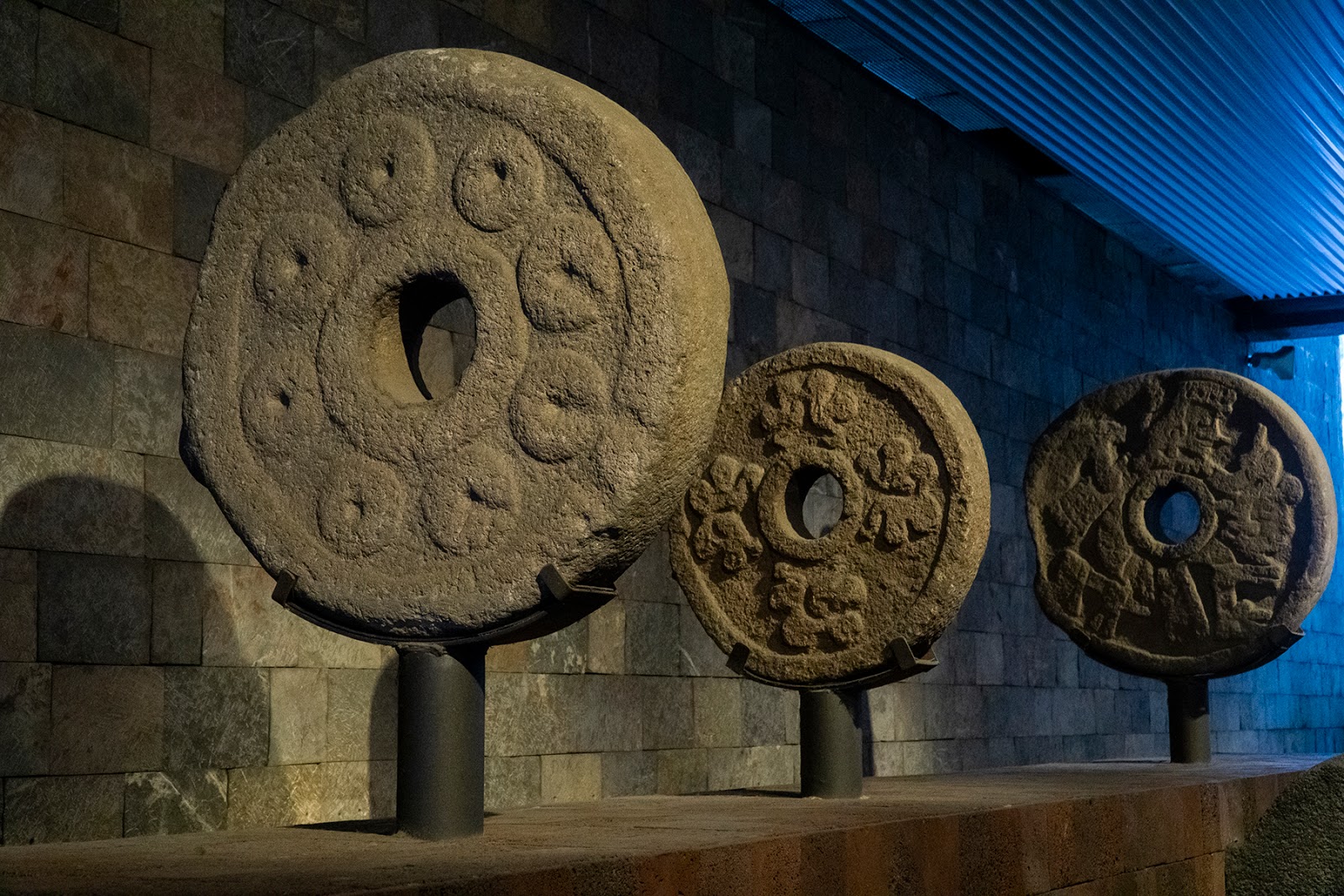
Ball Court Hoop, Anthropology Museum, Mexico City (Author's collection. copyright 2019)


Due to their out-lying locations, it is surmised that these two sites were actually trading posts due to their proximity to Chacoan/Mogollon settlements.  Commerce activity in this region was very dynamic during this entire period and shouldn’t be thought of as locked containers passing customs checks with end user certificates for verification or even clipboards with inventory lists received via Email.  It was more like the old town five and dime store owner who was aware of all facets of inventory and supply/demand in his head because he was familiar with every nuance of change that his town and customers experienced.  

                          
Ball court marker, Teotihuacan (Author's collection. copyright 2019)
Trade continued like this for a long time but in about 1,000 AD things began to change; that is when social complexity changed in the Sinaloa region of today’s Mexico: the southern end of the Chihuahua Corridor.  The Chalchihuites were the northern most representatives of Mesoamerica culture and between 950 and 1150 AD their seat of power was the city of Zape in northern Durango.

Ball court hoops from Teotihuacan, Anthropology Museum, Mexico City (Author's collection. copyright 2019)


Monday, October 7, 2019

Globalism in the American Southwest


    We are not the first culture to have and rely upon international trade.  If we feel that way, perhaps it’s because we coined the term “globalism” to reflect our connected global marketplace.  Unfortunately, that is the only contribution we made to global trade.  The spice roads connected China and Europe via Persia and India for thousands of years before an unknown Venetian sailor in a Genoese prison recounted his travels to the East.
    Cultures are only the sum of their societal input regardless of how diverse they may be.  Life in the Roman Empire was completely different depending on whether you were in Gaul or in Palestine but it was Roman life none-the-less.


Pueblo Bonito, Chaco Canyon, New Mexico, USA (Author's Collection. Copyright 2015)

    Perhaps this overview should be applied to the Ancestral Puebloans.  In an attempt to explain the chasm of unknowns associated with their history, today’s scholars are trying to invent their own “Theory of Everything”.  Sadly, they are precluding obvious and significant facts in order to do it.  The largest fact is that the Chaco World conducted significant, long-distance trade not only with their contemporary societies, but also with Mesoamerica and there is evidence of even wider commercial circles.  These Ancestral Puebloans had contact with many external societies and being highly adaptable people, they traded for different goods from different regions: Sea shells from the West Coast, Macaws and cacao from Mesoamerica and copper ornaments which may have come from The midwest state of Missouri in today’s United States.  As we do today, Chacoans used what they could, acquired what they needed and tried to leave a better world for their children.  So, when studying a culture that provides no eye-witnesses and only limited recorded resources, we must be careful not to be fooled by the facts.  Because of this situation of limited resources, we rely heavily upon archaeology and, to a lesser degree, the oral traditions of today’s Puebloan tribes and it is imperative that we do not use any single-source of input if we hope to arrive at a viable conclusion. 

Kin Klizhin Tower Kiva, Kin Klizhin Outlier, New Mexico, USA (Author's Collection. Copyright 2015)


    The conclusion is that Chaco Canyon was, for centuries, a vibrant culture diffused throughout the Four-Corners Region of today’s United States that had contact with their contemporary cultures both near and far.  The level of this contact differed over the centuries but left its indelible mark on Chacoan Culture for the rest of time.  Chacoans assimilated many cultural traditions, both good and bad, and, in the end, all these forces - internal, external, cultural, socio-political and environmental - forced Ancestral Puebloans to abandon their homes and disappear into time.

Pueblo Bonito, Chaco Canyon, New Mexico, USA (Author's Collection. Copyright 2015)