Showing posts with label intrigue. Show all posts

Monday, March 16, 2020

A Land of Myth, Mystery or Men?

 So if this Golden Fleece thing was just a smash and grab job, why is Georgia so important?  

    It would seem that Georgia has been a crucible for mankind since before we were mankind.  As related in an earlier edition, multiple Pre-Homo Sapien specimens have been found in the region of Dmanisi.  Under present anthropological understanding, the importance of this find would have been meaningless - or worse, mis-interpreted - were they not found in such close proximity to each other, as in Dmanisi.  As I understand it from reading in the Georgian National Museum, this has never been found before.  Why were our earliest humanoid species discovered together outside Africa in Georgia?  A distance of at least 1,600 kilometres (1000 miles).  Could they have been at the meeting with God (entry 24 February 2020)?


Skull, Homo-erectus(Author's collection)


    As noted in the last several entries, evidence of contact between Hellenic Greece and western Georgia was effected in approximately1200BC through Jason and his Argonauts but their knowledge of the Golden Fleece in Greece begs the question: who told them about it?

    In Greek Mythology we encounter Prometheus.  A demi-god of the heroic nature but one that ran afoul of his full-blooded cousins by stealing the secret of fire and giving it to mankind.  For this transgression, he was chained to a mountain top where an eagle pecked his liver out by day and it re-constituted itself by night.  That mountaintop was non other than Mount Kazbegi located in Georgia on the border with Russia along the Georgian Military Highway.  Georgian mythology has a similar character who suffered the same fate named Amirani.  Did Jason return with that bit of information too?


Mount Kazbegi centre image (Author's collection copyright 2020)


    The concentration of unique languages is prolific in the Caucasus as well.  It seems that every mountaintop speaks a different language (not dialect) and most are too old to have an alphabet.  The Georgian alphabet itself is among the oldest in the world.  Interestingly, mythology comes to the rescue here as well.  Local legend has it that while distributing languages to the world’s people, God placed all the languages in large panniers and mounted them on a donkey for easier transport.  While walking over the Greater Caucasus Mountains, the high, jagged peaks tore the bottom of the panniers and many languages fell across that small area before the holes were patched.


Georgian village in Svaneti Region of Georgia
(Author's collection copyright 2020)


    Life in the Caucasus has never been easy and it takes a hearty breed to survive.  It stands to reason that anyone standing out in a crowd like that would be legendary in their exploits.  This holds true for Georgia.  Many larger-than-life characters have existed throughout time.  King Vakhtang Gorgasali was said to have been deer hunting one day in the fifth century AD.  He was in an unfamiliar region, a bog-ridden area next to the Mtkvari River when he wounded a stag with an arrow.  King Vakhtang chased the wounded deer into the bogs where it disappeared from site through the morning mist but he heard it fall into the marshy waters.  So sure was he that the animal was dead that he ran forward unprepared, only to see the stag emerge from the waters unharmed and run away unscathed.  Bewildered by this, he investigated the reason for it and is credited with discovering the curative waters which gave rise to the city of Tbilisi: the capital of today’s Georgia.


Hamams in Old Towne Tbilisi (Author's collection, copyright 2020)


    Later, after a war with the Ottoman Empire, Tsarist Russia was trying to “Tame” their recent acquisition called Georgia and many a hard man was drawn to the Caucasus to test his mettle and make his fame.  In fact, a large body of Russian literature is linked to the wars of oppression in the Caucasus and one of the greatest insurgencies ever fought took place there: driven by the unbending will of its best known leader, Imam Shamil, an Avar from today's Daghestan.  With drive in mind, history would soon recognise another Georgian: Ioseb Dzhugashvshvili.  We remember him as Josef Stalin and he killed millions of people trying to impose his will on the world under the guise of communism.  


     Perhaps, unbending will is the true mystery of the land God reserved for himself.  Each individual I met there, over decades of interaction, was a force to be reckoned with - men and women both.  So if the region's mystery is, indeed, the unbending will of men, Caucasians most likely created the circumstances from which myth emerged and with this en-ending supply of wilful people, the Caucasus has remained prominent in the development of mankind since the dawn of time.


Monday, March 9, 2020

So what really happened?

      Legend tells us that a generation before the Trojan War, in ancient Thessaly, King Pelias stole the throne from his half-brother King Aeson.  In doing this, Pelias made a dangerous enemy in Aeson’s son, Jason, but sent him off on a quest to the empire of Colchis (modern day Georgia).  If completed successfully, this quest had the ultimate pay-off - Jason would be crowned king of Pelias and if he failed, Jason would pay the ultimate price.  To this end, Jason surrounded himself with some of the greatest heroes of the day and it was these heroes and their exploits that grew into legend.  This is the story first related in the third millennium BC by Apollonius of Rhodes entitled, The Argonautica.
All legends are based in truth and this one is no different.  It would appear that wealth and nation building were paramount to would-be-kings even thousands of years ago.  All empires need a financial reserve as well as sustained revenue and it was well known that Colchis was rich in gold. What made them so rich was their particular methods of acquisition.  The Rioni River and its tributaries were populated with wooden vessels outfitted with sheep skins that would take advantage of the rivers’ currents to sift the gold particles as they flowed out of the Greater Caucasus Mountains.  It is not hard to believe that over the millennia, such a simple but revolutionary technique would become the myth of the Golden Fleece.

Colchian earrings - circa 1st millennia BC. (Author's collection, Copyright 2020)

If true, it would seem that the real reason for this exploit was the acquisition of technology - not a simple smash-and-grab robbery.  Think of it like the old adage, “give a man a fish and feed him for a day.  Teach him to fish and you’ve fed him for life.”  Is that the real reason Jason surrounded himself with demi-gods?  How else could one expect to acquire such sensitive information?  

Jason knew that he had to have every skillset possible in order to have any chance of success.  

       Historians and storytellers differ in their passenger list aboard the Argo but generally agree that 50 crewmen were necessary and among the crew there are a few names that always appear: Heracles, Castor, Pollux, Peleus and Telamon.  It was these men, with their varied specialties and capabilities, who had been brothers in arms for such a long time that made Jason's success nearly a forgone conclusion.

Necklace from Vani, Georgia - circa 1st Millennia BC. (Author's collection.  Copyright 2020)


So we see that financial stability and corporate espionage were most likely the basis for the exploits we call the Quest for the Golden Fleece and in an effort to ensure success, Jason surrounded himself with men capable of a variety of skills - skills like; cunning, strength, intelligence and endurance.  Skills that may or may not be required for success but whose lack, when needed, would ensure failure. 
        Yet, in the end we see that for all his planning, preparation and coordination, it was an unforeseen capability that won the day for Jason: magic.  The magic of love when Medea fell for Jason and agreed to help him steal the Golden Fleece from her father, King Aeetes of Colchis.

Bracelet from tomb in Vani, Georgia - circa 1st Millennia BC.
(Author's collection. Copyright 2020)


Monday, February 24, 2020

Why Colchis?


"The wealth of the regions about Colchis, which is derived from the mines of gold, silver, iron and copper, suggests a reasonable motive for the expedition of Jason."

Strabo, Geographica, 1.2.39


Excavation at Vani, Georgia - Colchian city.  (Author's Collection. Copyright 2020)

    In today’s “age of reason”, we use science to explain our world.  In the previous world it was religion that explained how things worked and before that, it was myth that gave reason to our world.  

Strangely, even today, the Caucasus is a world of myth.

    Myths and legends carry a powerful message through time - how the tellers of these tales view themselves.  Every tribe under the sun has these stories - each rooted in a time too distant to remember and each of them fascinating.  Yet all of these legends have one thing in common - they stand the test of time.  We, as people, are inextricably bound to the past: it makes us what we are today and shapes what we will become tomorrow.  One could even say that without the past there would be no future.


Waterfront in Batumi, Georgia - eastern Black Sea (Author's Collection. Copyright 2020)

    Strabo describes the wealth of an ancient civilisation as the plausible impetus for one of history’s most enduring myths but perhaps the wealth described by Strabo above can be explained by an even older Georgian myth.

In the beginning, God created the Earth and all its people.  He then asked all the people to attend a gathering so that he may parcel out all the lands of the Earth to them for habitation.  On the appointed day, all the peoples of Earth gathered and received, from God, what we call today their ancestral homelands.  Conspicuously, one group of people was not present, but God went ahead and gave the lands out as gifts to those that were.  Once all the lands were dispersed and the people departed from the gathering, the one missing group arrived.  God said unto them, “My children, I’m sorry but you are late and no land is left to be given unto you as a home.  Where have you been?”  The group replied to God that they had been feasting and toasting God’s good name and his benevolence and, according to their traditions, could not stop the feast in order to attend his meeting.  They apologised profusely but re-iterated that they were late because their particular form of worship had deterred them from arriving on time.  So the Lord spoke to this group of people and said, “You are a genuine and pious people who deserve a good homeland, as such, I will give unto you the place on Earth I had reserved for myself: Georgia.


10th century AD (approx) ruins overlooking Rioni River 
from Bagrati Cathedral in Kutaisi, Georgia
(Author's collection. Copyright 2020)

    God’s reservation of Georgia as his own refuge could be an acceptable reason for us to believe in the incredible mineral wealth of the region and through time, this could have manifested itself in the great wealth of the empire of Colchis.  This empire on the eastern end of the Black Sea in today’s Georgia was the target of Jason and his boatload of adventuring heroes.

Colchian anthropomorphic figures in main sqaure fountain. Kutasisi, Georgia
(Author's collection. Copyright 2020)


Monday, January 27, 2020

Time and Patience: the Most Powerful Warriors. Part Six

    Our quest for calendrical stations continues on the western end of Chaco Canyon.  Peñasco Blanco was rumoured to have a calendrical station marked by standing stones (according to Cosmo Mindellef in 1891) but the area can’t be found today.  Even further west, approximately five kilometres, is another great house: Casa del Rio.  This relatively small house (21-27 rooms), strangely, has produced the largest refuse pile of any other Chaco Canyon house.  It is along the Great West Road and has signs across the site of increased pedestrian traffic which may indicate avenues of ritual procession.  Additionally, the amount of refuse being dumped here decreased in/around 1100AD - just when a resurgence of building in Chaco Canyon proper began.  This all may suggest that Casa del Rio was a very important early festival site.  Visually, from Casa del Rio the Winter Solstice sun would have risen over a shrine on West Mesa named 29SJ 1088 - which sits on the highest feature on the southeastern horizon from Casa del Rio.  Additionally, use of selenite reflectors or fires would allow for instantaneous notification over the eight plus kilometres distance into downtown Chaco(Signal Towers, another topic for another entry).  
    The last category has to do with the larger application of Chaco Canyon itself as an observatory.  Recent data concerning this was uncovered by Anna Sofaer, Robert Weiner and William Stone and published in 2016 in The Science of Time 2016, entitled, Inter-Site Alignments of Prehistoric Shrines in Chaco Canyon to the Major Lunar Standstill.  

Satellite imagery showing location/inter-relationship of Chacoan shrines relative to the major Lunar standstill (taken from Inter-Site Alignments of Prehistoric Shrines in Chaco Canyon to the Major Lunar Standstill, 2016)
This paper outlines the discovery of numerous masonry shrines spanning the distance of five to 15 kilometres which are aligned to the major lunar standstill.  This hypothesis is re-enforced by Geographic Information System (GIS) analysis of the spatial distribution of these sites and includes precise geodetic coordinates determined by the National Oceanic and Atmospheric Administration’s Geodetic Survey.  This data clearly shows these shrines and their inter-relationships along azimuths to the rising and setting moon at its major standstill. 

Azimuths between Chacoan shrines in previous image ((taken from Inter-Site Alignments of Prehistoric Shrines in Chaco Canyon to the Major Lunar Standstill, 2016)


    Overall, the evidence for calendrical stations in Chaco Canyon is overwhelming.  It is for us to try to decipher what they mean and what their role was in Chacoan culture.  It would seem that Chacoans did their best to improve calendrical precision by increasing vigilance in broader patterns across the ground while improving the speed of reporting to the central authorities.  With this in mind, we should ascertain that calendrical reporting was of paramount importance in the canyon.  Whether this was simply for projecting best corn and bean planting dates or used as a force multiplier in their quest for regional economic dominance may never be known.

Monday, January 13, 2020

Time and Patience: the Most Powerful Warriors. Part Four

Another manifestation of Archaeoastronomy extant in Chaco Canyon is Cardinal       alignments.  North-South and East-West building orientations predominated during the flouresence period in the canyon (1000-1175 AD circa) and were so important by that stage that, in the case of Pueblo Bonito, an existing great house was expanded upon and re-oriented from the original S/SE floorpan to North-South alignment.

(Imagery courtesy of Google Earth)


    As opposed to the ancestral veneration as the basis for the S/SE orientation, I have found no clear ethnographic reasons for the cardinal alignment.  In fact, our concept of the cardinal directions would not have existed for the Chacoans; their understanding of the world was not like ours.  Perhaps the emerging reliance upon North-South alignments during the fluorescence stemmed from Chacoan understanding of the rotation of the cosmos through direct observation.  Long term observation of their revolving skies may have brought them to the conclusion that the cosmos rotates from a single point on either end of their world (North-South).  Their daily observation of the sun’s patterns - either through direct monitoring, horizon calendars or employment of a gnomonic device (see part two) - would have given them a good understanding of what we call East-West and, together, these concepts could have been employed to revitalise a flagging theocratic civilisation based upon this new cosmic concept.  
    These rumination aside, we are left with only the facts. The reasons for these orientations are not clear, there appears to be no utilitarian reason for the cardinal alignment (much less its sudden importance) and there are no topographical restrictions that would require construction to adhere so closely to these alignments.  The collection of solar heating may have been a factor in general south facing construction but there is nothing extant to insinuate such strict adherence to a cardinal azimuth.  Recent archaeological activity in Chaco Canyon suggests that even at the height of its fluorescence, Chaco Canyon had a rather small population that population surged at intermittent periods.  This suggests a religious employment of the site and would explain why the area was so well organised and such care was taken in its large-scale construction.  In this scenario (religious centre) the attention to detail would make sense if these great houses were built as physical manifestations of Ancestral Puebloan’s cosmic concept.  If this idea were true, even the act of building the great houses would have become an act of faith or contrition.  An idea like that may be reason enough for individuals without knowledge of the wheel and no beasts of burden construct an intricate road system over which to transport tens of thousands of trees from distances of up to 80km for use in construction of these houses.
    The question is what happened to cause a change in construction management? During this fluorescence period - when a surge in great house construction took place - almost every building exhibits signs of cardinal point orientation and there are several cases of inter-site alignment along the cardinal points as well, which indicates an even greater level of civil engineering on behalf of the Chacoans.  The construction of several buildings within Chaco between 1040 and 1160 AD (finish dates) demonstrate a clear premeditation on behalf of the Chacoan leadership to inter-relate their construction developments with regards to their cosmic concept.  Pueblo Alto, New Alto, Tsin Kletsin and Casa Rinconada are all flourecence era construction that are not only built with respect to the N-S alignment but are also aligned to each other despite their positions being separated by almost five kilometres.   Pueblo Alto, finished in ~1040AD, with an internal alignment of 178.9º is directly North of Tsin Kletsin.  Tsin Kletsin, finished in ~1115AD and due South of Pueblo Alto - constructed with an internal alignment of 178.7º.  Interestingly, these two great houses are outside of the canyon proper, on the mesas North and South of the canyon and in sight of each other; leading to conspiracy theories concerning warning stations and internal strife.  New Alto is a smaller great house within sight of, and directly to the West of Pueblo Alto.  This New Alto great house was constructed in approximately 1130AD and is directly North (and also within sight of) Casa Rinconada.  Casa Rinconada is located in Chaco Canyon (away from other great houses) and was constructed in ~1060AD and has an internal alignment of 180.1º.


    Through all of this the enigma remains (or deepens) because as cardinal alignment began to supersede S/SE orientation as the predominant expression of archaeoastronomy in Chaco Canyon, we see that same S/SE orientation become predominant in the Totah Region of the Chacoan world.  This region was at the northern end of the Great North Road and the destination for many during the initial abandonment of Chaco Canyon.  This simultaneous shift seems to indicate a rift in cosmic concepts.  Perhaps those that believed in the old ways moved North and built Aztec and Salmon Great houses along with their associated outliers while the “new” philosophy of cardinal alignment took over in the Chaco core.  

Monday, November 4, 2019

War by Other Means, Part two


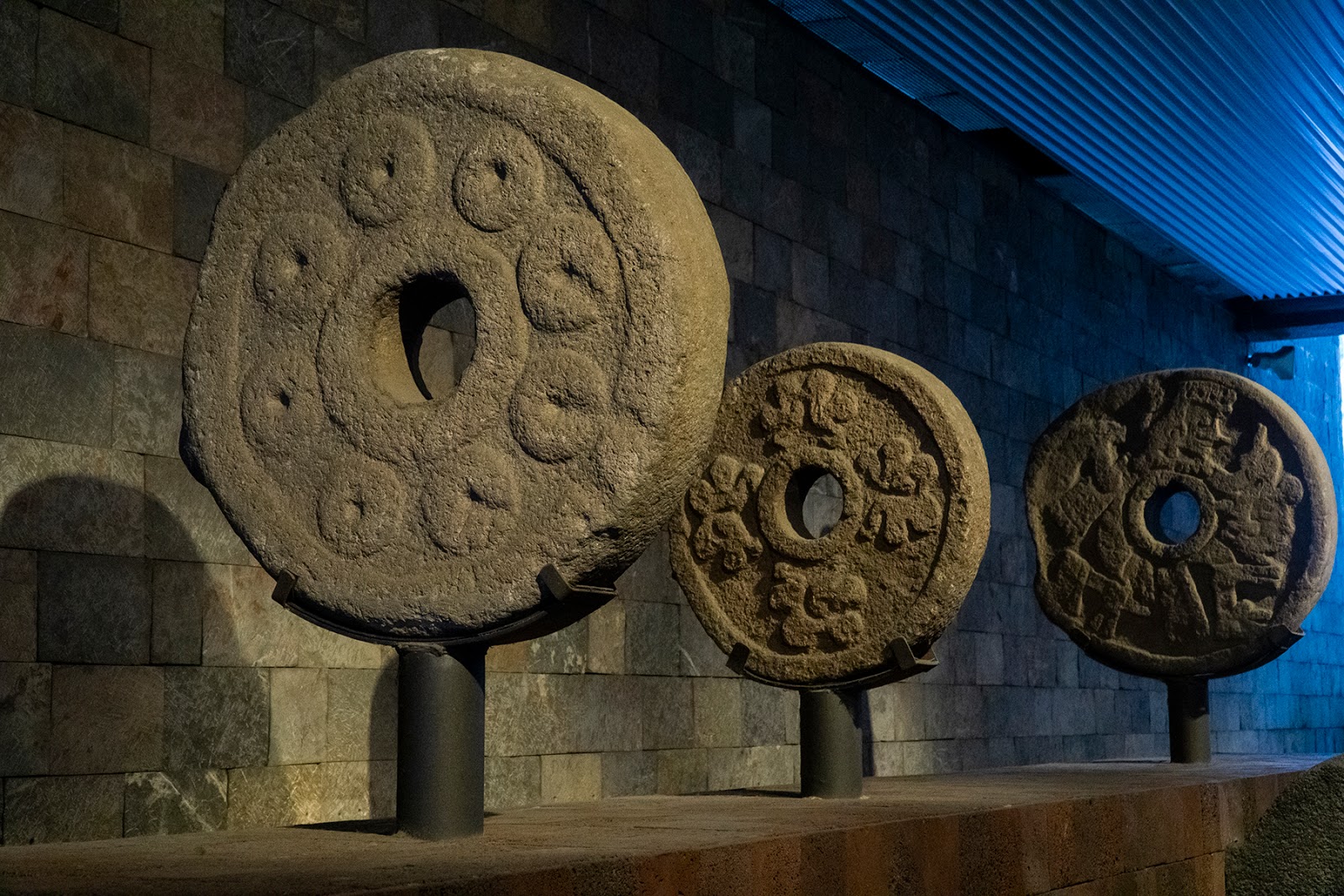
    Beginning in 300 BC, the Hohokam tribes in today’s United States’ state of Arizona were heavily invested in the shell trade with Chacoan and Mogollon tribes.  To the extent that in the Papaguería area of today’s Tohono O’odham National Reservation, there is evidence of a large habitation site dedicated to the production and export of shells.  The period of 550-1150 AD saw the zenith of Mesoamerican goods finding their way into Hohokam culture via the Sonoran Corridor and it was in this time of increased Mesoamerica contact that Hohokam shell work achieved its highest artistic level.  As with trade, so too comes culture and Hohokam society seems to have absorbed a number of Mesoamerican traits: platform mounds and ball courts, to name a few.  In fact, by 600 AD there were even ball courts located at the remote Hohokam sites of Winona and Stony Canyon (outposts along the western birder of Chacoan territory).  
Ball Court Hoop, Anthropology Museum, Mexico City (Author's collection. copyright 2019)


Due to their out-lying locations, it is surmised that these two sites were actually trading posts due to their proximity to Chacoan/Mogollon settlements.  Commerce activity in this region was very dynamic during this entire period and shouldn’t be thought of as locked containers passing customs checks with end user certificates for verification or even clipboards with inventory lists received via Email.  It was more like the old town five and dime store owner who was aware of all facets of inventory and supply/demand in his head because he was familiar with every nuance of change that his town and customers experienced.  

                          
Ball court marker, Teotihuacan (Author's collection. copyright 2019)
Trade continued like this for a long time but in about 1,000 AD things began to change; that is when social complexity changed in the Sinaloa region of today’s Mexico: the southern end of the Chihuahua Corridor.  The Chalchihuites were the northern most representatives of Mesoamerica culture and between 950 and 1150 AD their seat of power was the city of Zape in northern Durango.

Ball court hoops from Teotihuacan, Anthropology Museum, Mexico City (Author's collection. copyright 2019)


Monday, October 21, 2019

Loose Ends, Part Two

    During the Republic's early days, Trotsky served as the People's Commissar of Foreign Affairs then the Founder and Commander of the Red Army by serving as the People's Commissar of Military and Naval Affairs.  As such, he was a major figure in the civil war victory.  
Trotsky office where he was mudered. (Author's collection. copyright 2019)
    After Lenin’s death, Trotsky led the failed struggle of opposition against the rise of Joseph Stalin and his ever increasing bureaucracy.  He was removed from the Politburo and the Central Committee, expelled from the Communist Party and finally, exiled.  Despite this he continued to oppose Stalin's bureaucracy at the fourth Communist International (COMINTERN).  Trotsky's actions put him on Stalin's bad side and set him on a global odyssey seeking political asylum, being repeatedly turned away by western government’s.  Eventually, he ended up in Mexico City and agreed to acceptable terms with the government there about the scope of his political activities.  Trotsky was a theorist and prolific writer, his ideas were the basis for a Marxist school of thought called Trotskyism and he was writing a "tell all" on Stalin.   To say the least, this was not to Stalin's liking and he decided to act. 
    In 1940, Stalin sent a mole to assassinate Trotsky.  By Stalin’s thinking, the world could never know the truth about him and the party’s activities - the only version of the truth was his and there could be no dissent.  So, on the afternoon of August 20, 1940 in the Mexico City neighbourhood of Coyoacán, a trusted member of Trotsky’s inner-circle entered his house under the pretence of giving him a pen.  Once alone with Trotsky in his office, Ramón Mercador hit Trotsky in the head with an ice axe.  Trotsky died later in hospital and Mercador, the assassin, would spend 20 years in prison.  Stalin went on to exterminate Trotsky's family left in Russia, including his children, and re-write Soviet history without a mention of one of its greatest architects.

Mexican authorities with ice axe (Author's collection)

    It would be decades before the world began to see the evil Stalin represented and even more decades before the world understood that communism was a failed experiment.  Yet today, in the United States, the greatest democratic nation in the world,  Politicians are openly calling for the violation of that nation's constitution in order to place their constituents in mortal danger, while they try to re-create this experiment.  Lev Trotsky's story should prove as a cautionary tale to these would-be courtiers to the ruinous and rapacious exercise that is communism.

Leon Trotsky's internment, Mexico City. (Author's Collection, copyright 2019)