Showing posts with label evolution. Show all posts

Monday, September 9, 2019

Genetic Encoding. Part one of two

    250,000 BC is the earliest date of human activity in the area we now call Egypt and by 3,100 BC, legend tells us a Pharaoh by the name of Narmer had united the region between the Mediterranean Sea and the first cataract (present day Aswan).  For the inhabitants of this region, they have changed and adapted so many times that they are unaware of their innate ability to compensate for the inconsistencies of others.  
    
Egyptian Hieroglyphs, Egyptian Museum (Author's collection copyright 2019)

    During our 247,000 year interval between the above dates Africa became victim of climate change and the rich savannahs became arid, forcing the nomads living there to migrate closer to the Nile River.  Rains further south ensured that the Nile flooded annually - like clockwork - and when those floodwaters tapered off the soil of the surrounding countryside was enriched by silt and soils from all over eastern Africa.  This presented the opportunity to farm and Egyptians don’t hesitate to capitalise on something good.  Sadly, one must take the good with the bad in life and social order came along with farming and Pharaoh placed himself at the top- as all leaders do - and the farmers at the bottom.  Pharaoh himself is credited with establishing social order but the claim is buttressed by archaeological evidence from 3000 BC (circa).

    
Pyramids of Giza(Author's Collection, copyright 2019)

This simple restructuring forced many changes on the population of ancient Egypt but nature did too and the flood period provided a natural respite for farmers which Pharaoh most likely capitalised on by using them as unskilled labour supporting his engineers and architects in building his elaborate infrastructure.  What a summer job, building those magnificent pyramids and monuments, even if you are just hauling baskets full of rubble.  The chaos caused through the ensuing years by multiple changes to the physical location of the Egyptian capital, not to mention adjustments and refinements to the state religions must have had a disorienting effect on the populace but they kept working, trying to make a better tomorrow for them and their families.

Monday, August 26, 2019

If it Ain’t Broke…


    I am neither an architect nor an Engineer by trade.  I am a natural tinkerer and have spent most of my life breaking my toys, so I have an appreciation for how things are made and what it takes to make them.  As such, I spend a lot of time noticing differences in construction: things like the pathetic stitching on the snaps of Hasbro’s G.I. Joe camouflage fatigues the last year they were made.  Incidentally, I still have a set of those cammies from their first year of production.  Bombproof!
    This is all a way of saying that newer isn’t necessarily better.  Last week I was watching a re-run of a World War Two documentary in which Germany invaded France by running around the Maginot line.  While discussing river crossings and their importance to military operations, historic film reels were played showing a German tank crossing a makeshift bridge; one hastily constructed from little more than timbers laid across numerous small boats.  This bridge struck me as familiar and I began to sift through my library for references to this construction as it seemed out of place in this German war footage.

Screenshot of bridge by author

   I worked backwards in time and was consulting J. Caesar’s The Gallic War without finding my bridge, so I looked further back in time.  Finally, I found it.  The description went something like this:  
    
Many boats (654) were placed side-by-side and facing into the current while cables were used to secure them to the shore and the individual bows were anchored up and down stream to keep the boats in line relative to each other and adding more stability.  Boards were then placed between the boats and over the cables to connect them while brushwood and soil were placed over the boards to create a walkway and a more even surface after which a handrail was placed on either side to keep soldiers and beasts of burden from falling in. 


Author's image of a bridge in Afghanistan taken from The Histories

    This resource that listed my bridge was actually Herodotus when his Histories were describing how the Persian Empire invaded Greece.  Xerxes used this bridge type to cross the Hellespont in 482BC (circa).  This narrows is approximately 1240 metres (1350 yards) of the most difficult waters in the world.  This successful iteration was actually the second effort.  The first had ended badly for all: the engineering supervisors were beheaded and the waters of the Hellespont were flogged with 300 lashes while being subjected to verbal abuse for being disobedient.  


Author's image of a sketch from The Histories  


So, in 2019 I saw a film from 1939 which spoke about how technologically advanced the German Army was and how incorporating this technology gave the Germans a battlefield advantage.  Yet in this film, our twentieth century technological genius’ used a bridging technique from 2,421 years earlier.  Perhaps part of their genius was their ability to recognise when something works well.

Monday, August 19, 2019

Greek Fire


    Since the dawn of time man has been competitive.  Perhaps that is what has set him apart from the rest of the animal kingdom: Faster, farther, better - regardless of the endeavour.  This is especially true in warfare.  More efficient means of vanquishing the opponent has always found an audience: and so it was with Greek Fire.

    In the early days of the Greek city states and of the Roman Empire, the use of incendiaries in combat was rampant and the unpredictable nature of Greek Fire made it as hazardous to the employer as it was to the intended victim.  Yet, the ability to throw fire from one point to another in a focused and directed manner was very desirable, so pyro-masters kept refining the process through trial and error.  Finally, in about 668AD, a Greek refugee from Syria arrived at Constantinople with a proven recipe.  By 672, Kallinikos, as our Greek was called, had perfected his delivery technique and was using it to defend the Eastern Roman Empire against invaders.  Legend has it that this version could set water on fire and actually burn underwater.  

Image of a 12th century manuscript (Author's collection)
    All mythology and nonsense, right?  Except that napalm and white phosphorous fit these descriptions and were used to great effect during the wars of the twentieth century.  Throughout time there were other munitions that created races to develop and acquire regardless of the cost in dollars or humanity.  The atomic bomb is an excellent example of today’s Greek Fire as the centre of the mushroom cloud over Hiroshima, Japan reached five thousand degrees centigrade.  Add to that the fact that the second bomb (made of plutonium, not uranium) was so unstable that it had to be tested in the New Mexico desert prior to being dropped on Nagasaki and due to the arms race (both before and after) created by its introduction we see many parallels with Greek Fire. 

    Even today, the search for the proper recipe continues.  In early August 2019, there was an explosion west of Archangel, Russia and, subsequently, the town of Nenoksa was evacuated and all this was conducted under a veil of mis-information and retracted statements by the Russian Government.  What ever their cover-story may be, the most likely happenstance is this: The Russian military was testing a Skyfall missile (a nuclear missile powered by a nuclear reactor) that went awry.  The best bet is that its portable nuclear power station melted down in a smaller version of the Chernobyl, Ukraine tragedy.  Most certainly, the power station was one of a new offering by the Russian firm Rosatom.  Rosatom stated last year that they envisioned their new portable reactors being used in a fleet of nuclear-powered ice-breaking ships in support of Russia’s efforts to open (then dominate) the Northern Sea Route: thus connecting the Atlantic and Pacific Oceans via the Artic.

    Keep in mind that through all of this, Russia has no overt enemies and the only international enmity directed towards them is because of their meddling in external, sovereign affairs.
Close-up of the above manuscript (Author's collection)


Is this the fallout from today’s Greek Fire?

Monday, July 29, 2019

Homecoming, another word for respite

    Under the warm, wet blanket of a Virginia summer's eve, I am standing on the curb at the airport arrival terminal, awaiting my ride home after a few weeks abroad.  This is where I love to be.  I have renewed my faith in mankind by viewing the countless happy reunions inside the terminal and, now, I am waiting on my own.  My wife will be here soon - she's caught in traffic.  After years of traveling for a living I still love this evolution and I have seen all forms that it can take.

Bazaar in Lahore Pakistan (Author's collection Copyright 2019)
    Parades and receptions have been the recent form of fanfare for returning heroes but that wasn't always the case.  Homer tells us that after twenty years of war fighting and mis-adventures, Odysseus returned only to find his home being ravaged, his wife being pressured to leave him and his kingdom on the brink of collapse.  Luckily, this most cunning man had the wherewithall to unmask and dispatch his enemies in one well-orchestrated stroke.  On the other side of Greece, in Mycenae, Agamemnon wasn't so lucky.  His wife and her lover killed him in his sleep.
    Perhaps, Agamemnon was delivered from himself in this tragic event: saved from a future that he couldn't see because of his desire to return home. Tennyson has followed up with an exploration of this sentiment.  Through the ageing eyes of Odysseus who, after fighting his way to the underworld and back with the sole purpose of regaining his home had become bored and longed for the adventure of travel once again.

...For always roaming with a hungry heart 
Much have I seen and known; cities of men 
And manners, climates, councils, governments,... 


Erg Chgagah, Morocco (Author's collection copyright 2015)
Travel is a heady concoction that plays on the senses like a highly addictive drug; eventually seducing you into what you try to rationalise is your last time.  Tennyson's Odysseus understood this intrinsically when, despite his advanced age, he stated his intention to turn his kingdom over to his son and roam the wine-coloured seas in search of adventure.
Japanese garden icon (Author's collection copyright 2019)

...Come, my friends, 
’Tis not too late to seek a newer world. 
Push off, and sitting well in order smite 
The sounding furrows; for my purpose holds 
To sail beyond the sunset, and the baths 
Of all the western stars, until I die. 
It may be that the gulfs will wash us down: 
It may be we shall touch the Happy Isles, 
And see the great Achilles, whom we knew. 
Tho’ much is taken, much abides; and tho’ 
We are not now that strength which in old days 
Moved earth and heaven, that which we are, we are; 
One equal temper of heroic hearts, 
Made weak by time and fate, but strong in will 
To strive, to seek, to find, and not to yield. 

So, I load my bags into the car and hug my Wife as though I haven't seen her in a lifetime.  We kiss and try to make up for lost time on the way home catching up on all the happenings since our separation.  Yet, although all this electrifying human interaction is genuine, it is perhaps made sweeter by the quiet realisation that this homecoming is really just another respite.

Aquarius Habitat, Key Largo, Florida, USA(Author's collection copyright 2015)

Sunday, July 21, 2019

Disney Wasn't the First

    My Daughter and I love to go to the cinema.  It is our go-to for our Daddy/Daughter date night.  After the film, we will talk for hours over burgers and chips discussing the subtle nuances of our most recent film.  In fact, our discussions often continue for days on this subject until we have begun to explore new ways of telling the same story and delved into fresh ideas about the meaning of the film and the intentions of the creators.
ZamZamma in front of the Lahore Museum (Author's collection, copyright 2019)
    I was recently in Lahore Pakistan and no visit there is complete without a stop at the Zamzamma and the Wonder House, in front of which it stands. These terms are, of course, from Rudyard Kipling's Kim and like every twelve year old boy prior to the eighties, I spent some of my time buried in the pages of that amazing book.  So, while I was at the Wonder House last week, I purchased a copy of Kim as an homage to a writer whose works helped shape my outlook on life.  Through those pages, I was delighted to, again, travel by te-rain through India and pursue Russians through the high passes of Afghanistan.
The facade of the Wonder House, Lahore (Author's collection, copyright 2019)
    The strange thing is that as I read the story for the first time in decades, I saw things from my adult perspective - not that of a twelve year-old boy who had never left the farm.  Here was a story I hadn't read before.  A story of intestinal fortitude and intrigue as its own reward that could have been placed anywhere in the last twenty years of the Wars on Terror.  The boyish fantasy which I remember was still there, but I didn't remember the extent of deep underlying foreboding and impending doom, as well as the heavy emphasis placed on personality assessment and exploitation.  I started to realise the depth of the storyline in this book and, over the course of the week, my internal monologue about this book started to sound like the post-film discussions I have had with my Daughter all her life.  Somewhere around 0230 yesterday, I realised that Kim was the fore-runner of the Disney-Pixar films.  These films have delighted families since 1995 by providing relevant, multi-dimensional entertainment for the entire family.  Children and parents alike were excited to go to these films because there was something in them for all and, in the end, there were hours of conversation stimulated by the cinematic experience.
    That is exactly what Kipling did with Kim.  Families discussed their interpretations of the subject matter because India is a foreign land to most Westerners; not to mention the unique and nebulous nature of the Great Game.  At the end of all this ruminating, I realised that Disney-Pixar - though incredibly talented and creative as a group - wasn't as innovative as I thought they were all those years ago.  They merely employed an age-old, proven technique for mass entertainment that had not been used for some time, so the novelty was palpable.  Rudyard Kipling made great use of this one hundred years before Disney in his timeless classic, Kim, as it is a vibrant and riveting story for children of any age that explores and challenges the instincts of us all.


Monday, July 8, 2019

Keeping the Media at Bay

Image of Alexander's Sarcophagus(Author's collection)
    What to do with a precocious child who meddles in adult's business?  Today, I'm not sure but I know in my childhood, an immediate and severe beating would ensue coupled with some sort of long term misery was the prescription.  In fourth century BC Macedonia, he was made a king.  At least that's what happened to Alexander, son of Phillip II.  Although this precocious child went on to conquer the known world he was still meddlesome in his youth and erratic in his behaviour.  Of all the topics Aristotle taught Alexander, it seems that he learned one lesson very well; how to control his image with the public.
    We know from contemporary biographers that he was creative in his reports back to Macedonia but this is all second-hand speculation as not one of those biographies is extant today.  We are forced to rely Arrian and Plutarch and Rufus - all of which were writing hundreds of years after the fact but cited these originals as their sources.  Could it be that today's generals could take another, more subtle, lesson from Alexander's playbook?
    By all accounts though Alexander was a master of perception management and it would seem that this has extended through the years.  Despite many indicators that Alexander was impetuous and emotional, his reputation today is that of a great leader who managed his meagre resources superbly.
    This was achieved by limiting the exposure outlets that were available to the public and controlling them completely - Callisthenes (an embedded biographer) didn't make it home alive.  Centuries later, the worst that chroniclers could do was to highlight the ire of Alexander's troops over his tendency to "go native" but not one of these writers has acknowledged the need for Alexander to ingratiate himself to the recently defeated and still restive native populations that surrounded him and his small band of Macedonian soldiers.  Additionally, our writer's have never been placed in perspective themselves; they were spinning a moral tale for a specific audience in their own times.  This story became cautionary over time towards their own leaders - An intrepid westerner is seduced by the vices of the East which eventually kill him.  In other words: don't be like Alexander, cling tightly to your Roman values while serving the Republic in far-flung corners of the realm (their audience was Rome).  It would seem that the media has been a tool of the ruling elite for quite some time.

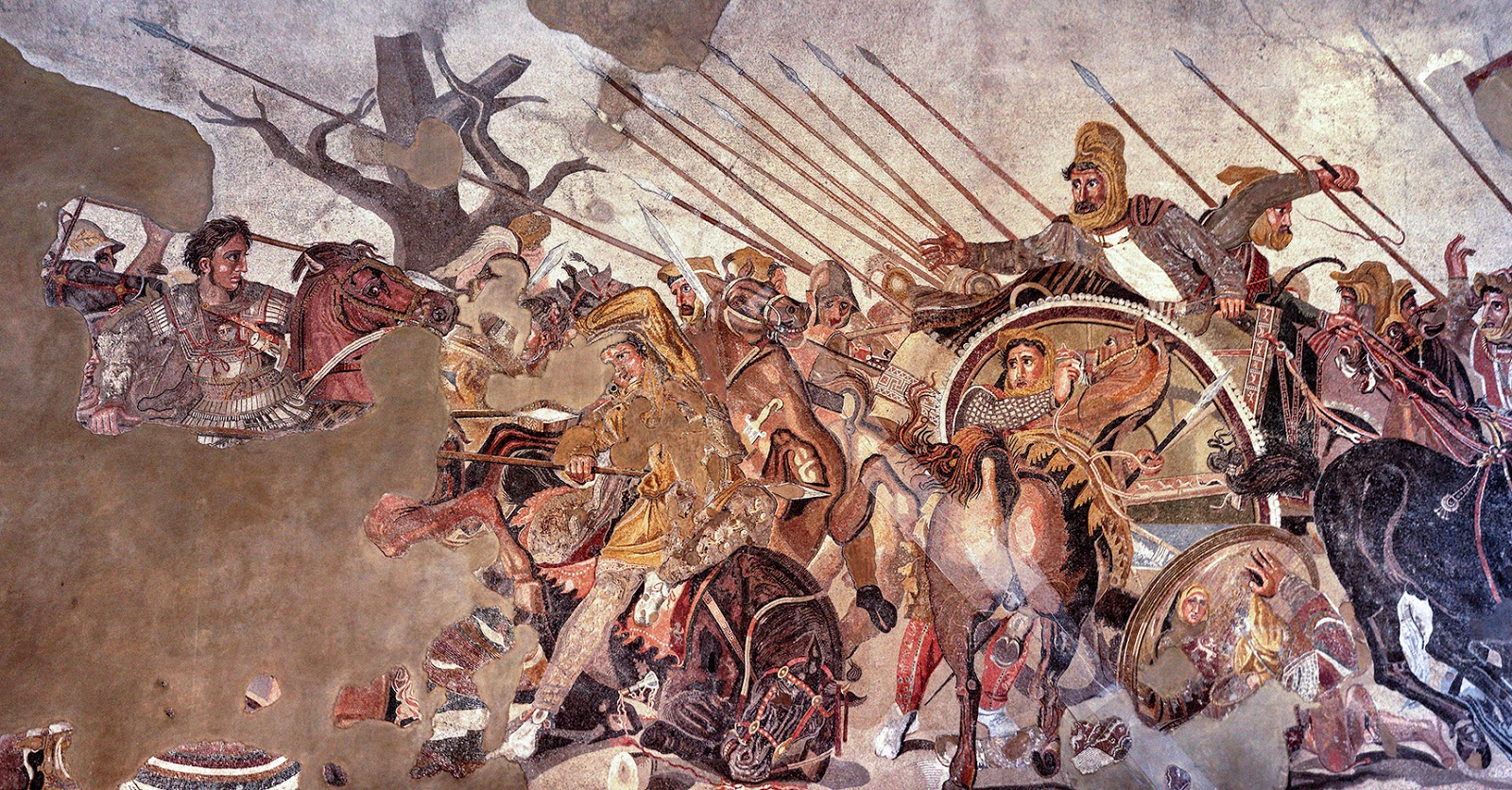
Alexander against Darius III at Issus. A 1st century BC floor mosaic from Pompeii, Italy. (author's collection copyright 2013) 
    It is readily apparent to me that today's media - in their self-driven 24/7 need to produce information for and grab ratings from an lethargic and saturated audience - has dug deeper into our military's conduct than they need to.  Our general's today should take a lesson from Alexander and keep them at bay - feeding them the relevant stories for public consumption instead of allowing these embedded reporters to dig up the worst and most irrelevant rumours to report as facts to an already naive public who doesn't understand what war fighting is all about.


Monday, June 17, 2019

Georgia, The Reason Travel Was Invented? (Part two of two)

View from Meteo Station on Mt. Kazbeg (Author's collection, Copyright 2014)
     

    Not too long after that - but long enough for the Greeks to forget their first alphabet- there was another interest in Georgia.  A generation before the Trojan War (1205BC) this interest was on behalf of the Greeks in their search for the Golden Fleece.  Colchis is on the eastern end of the Black Sea in modern day Georgia.
      There is much speculation over the exact location of the Colchian capitol but most agree it was either Kutaisi, Poti or Vani - each located along the Rioni River.  At any rate, the examples of gold smithing skills on display in Tbilisi's Georgian National Museum from that period are amazing and there is historical evidence that western Georgian gold mining techniques included using a sheepskin to pan the rivers.  Remember that this gold washed out of the Greater Caucasus Mountains - where Mt Kazbeg lies.
    In mythology, Jason and his intrepid crew of heroes that history has dubbed the Argonauts after their vessel, the Argo, made this daunting voyage to Georgia and we can place this story along a realistic timeline because Peleus was an Argonaut and the father of Achilles, who died at Troy.  So, despite all the adventures along the way (and back), Jason's real goal was to procure the golden fleece and procure it he did - as well as a wife, Medea, the daughter of the Colchian king, Aietes, who is the only reason they lived to depart Colchis.  
    
Archaeological excavation in Vani, Georgia (Author's collection, Copyright 2014)

    Further credence is lent to the interaction with Georgian society by a Greek Tragedy Play, "Medea", in which the couples stormy divorce is chronicled: Medea kills her three children by Jason, as well as Jason's new Fiancee, Glauke, prior to escaping in a flying chariot.  The credence is lent by the world renowned spite and fury embodied by Georgian women when scorned.
    These small details are the qualifiers that are overlooked in history.  The facts that, despite seeming to be trivial, are proof that a myth is actually history.  It is these qualifiers that we must turn a jaundiced eye upon in order to sift through the sands of time that obscure the past from our view.

Monday, June 10, 2019

Georgia, The Reason Travel Was Invented? (part one of two)

    A Georgian myth claims that Georgia was the land that God reserved for himself because of its natural beauty and abundant productivity.  Mankind seems to agree with this statement as he has been traveling there since the dawn of time and perhaps this region is the very reason for the concept of travel itself.  Historical vignettes may supply us with proof.
Dmanisi, Georgia (Authors collection, copyright 2014)
    As early as 1.8 million years ago, Georgia was attracting visitors.  A group of Hominids that we call Homo Erectus were the first human species to migrate out of Africa.  Since 2005, five skulls have been discovered near the Georgian town of Dimanisi - all within a 9.2 square metre area (~100 feet squared).  Because these skulls differ greatly, it is theorised that they represent a cross section of the species, in general, and are forcing scientists to re-evaluate the existing theories.  The most recent skull has a brain cavity about half the size of modern humans and a large face; if these were fragments, they would be categorised as different species.  The difficulty for scientists is that they were found together, a long way from Africa and within a 9.2 square metre area.  Scientists are now theorising that this species was more diverse than previously thought and the findings in Dimanisi may lead to grouping all homo fossils dated 1.8 to 1.5 million years old into a new, Homo Erectus family.


View from near Amirani’s(Prometheus’) prison on Mt. Kazbeg (Author's collection, Copyright 2014


More recently, on the summit of Mt. Kazbegi (5,054m), Amirani - we call him Prometheus - was imprisoned for giving fir to humans.  An added punishment was that an eagle would peck out his liver all day and over night, it would grow back.  The question is, Why in Georgia?  Was that because it was close to God's home?  Where better to keep an eye on a recalcitrant child than your backyard?
    It seems that before the dawn of time, before we were even ourselves, we were attracted to the bounty that is Georgia; the land that God reserved for himself and hasn't strayed too far from since.